


Mục lục
Steel bending is an advanced mechanical processing technology that utilizes the immense pressing force of a bending machine to transform flat steel sheets into precise profiles and angles according to design specifications. It is a key solution for optimizing the durability, aesthetics, and precision of products across the mechanical engineering, construction, and supporting industries.
Are you looking for a reputable provider of high-precision steel sheet bending services at factory-direct prices? Discover the capabilities and professional services offered by Intech Mechanical today.
Intech Mechanical boasts modern workshop facilities and a fleet of advanced CNC bending equipment; we are committed to delivering optimal bending solutions to our customers.

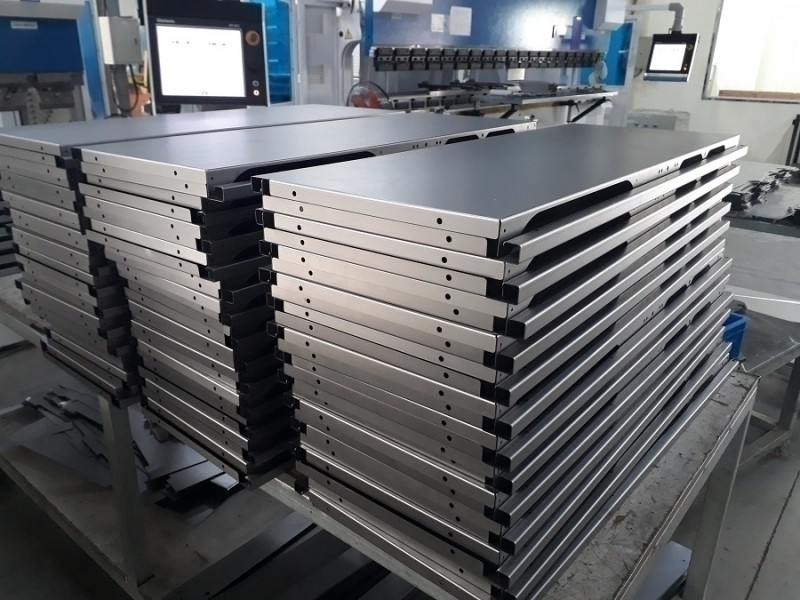
CNC Press Brake at Intech Mechanical
Need a quote for custom steel bending?
If you or your business require steel plate bending or structural component fabrication, please send your drawing files (CAD/STEP) and technical specifications directly to Intech Mechanical to receive the most competitive quote today!
Steel bending is a metal-forming process that utilizes high pressing force from specialized equipment, specifically a punch and die, to deform steel sheets or plates into specific angles, bend radii, and geometric profiles.
Unlike machining or casting processes, steel bending preserves the material's mass, altering only its geometric shape through plastic deformation in a cold-working state.
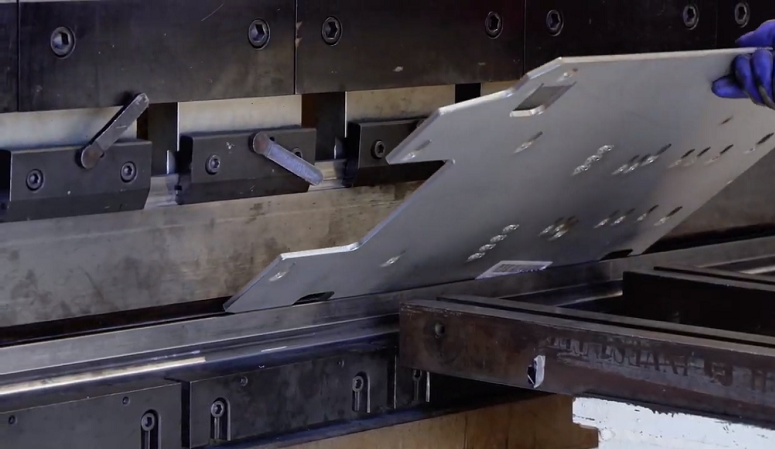
- Carbon steel bending (SS400, Q235, A36, S50C): Carbon steel is the most common material for bending operations.
- Galvanized steel bending (SGCC, SECC, DX51D): Galvanized steel coils/sheets featuring a corrosion-resistant zinc coating.
- High-strength steel bending (Hardox, SSAB, S355): Alloy steels characterized by high strength and hardness.
Step 3 – Selection of machine and bending tooling (Punch & Die)
Step 4 – Programming and parameter setup
Input data into the CNC control system. Program back-gauge positions and the bending sequence (1, 2, 3...), and set appropriate spring-back compensation angles for the specific steel type.
Step 5 – Steel bending execution
Install the bending tooling and calibrate the back-gauge. The operator positions the steel blank against the back-gauge and activates the machine cycle via the foot pedal. For products requiring a high-quality finish, a protective film or flexible rubber pad is placed on the die surface to prevent scratching.
Step 6 – Quality Control (QC)
Inspect the first product using angle gauges, calipers, and a 3D coordinate measuring machine (CMM). Measure bend angles, edge dimensions, and parallelism, and verify the surface for any cracks or fractures.
Step 7 – Finishing, Packaging, and Handover
Remove oil and grease, sort the products, wrap them in protective PE film or secure them on wooden pallets, and hand them over to the customer along with the technical acceptance documentation.
- Steel bending using mechanical press brakes:
Mechanical press brakes utilize a flywheel system and a crankshaft mechanism to generate the bending stroke.
- Steel bending using hydraulic press brakes:
Hydraulic press brakes operate using hydraulic oil pressure to drive cylinders that move the bending punch.
- CNC steel bending:
CNC (Computer Numerical Control) bending is the most advanced method available today, where the entire bending stroke, back-gauge position, hydraulic pressure, and crowning (deflection compensation) are automatically controlled via computer software.
Superior advantages:
Mechanical engineering and machinery manufacturing: Industrial machine casings, machine bases, motor mounting frames, safety guards, and technical mounting brackets.
Contact Intech Mechanical today to experience high-quality steel bending services!
Are you looking for a reputable provider of high-precision steel sheet bending services at factory-direct prices? Discover the capabilities and professional services offered by Intech Mechanical today.
Custom steel bending and folding services at Intech Mechanical
Intech Mechanical boasts modern workshop facilities and a fleet of advanced CNC bending equipment; we are committed to delivering optimal bending solutions to our customers.
Steel bending capabilities at Intech Mechanical:
- Custom fabrication based on drawings: Precisely meets complex technical specifications provided by clients.
- Modern equipment: High-speed, multi-axis CNC press brake systems offering 0.1mm precision and capable of bending steel sheets up to 4,000mm in length.
- Free DFM consultation: Intech’s engineering team reviews flat-pattern drawings, advises on optimal bend radii, and helps eliminate redundant steps to reduce costs for the business.
- Quality and schedule control: 100% of products undergo rigorous QC inspections before shipment, ensuring on-time delivery in accordance with the contract.
CNC Press Brake at Intech Mechanical
Quote for custom steel bending and folding services
| Steel thickness (t) | Bending type | Reference processing price (VND/bend) |
| 0.8mm - 1.5mm | Standard V-bend, U-bend |
Contact workshop for quote ›
|
| 2.0mm - 3.0mm | Standard V-bend, U-bend |
Contact workshop for quote ›
|
| 4.0mm - 6.0mm | V-bend, Z-bend |
Contact workshop for quote ›
|
| > 8.0mm | Specialized forming bend |
Contact workshop for quote ›
|
Need a quote for custom steel bending?
If you or your business require steel plate bending or structural component fabrication, please send your drawing files (CAD/STEP) and technical specifications directly to Intech Mechanical to receive the most competitive quote today!
Contact us for a consultation and the best quote. ›
Overview of technical knowledge regarding steel bending and folding
What is steel bending?
Steel bending is a metal-forming process that utilizes high pressing force from specialized equipment, specifically a punch and die, to deform steel sheets or plates into specific angles, bend radii, and geometric profiles.
Unlike machining or casting processes, steel bending preserves the material's mass, altering only its geometric shape through plastic deformation in a cold-working state.
Characteristics of the steel bending method
- Profile versatility: Capable of forming a wide range of shapes, from simple bends (V- or L-shapes) to complex profiles (U, Z, or C-shapes, edge trims, and concentric or eccentric cones).
- Scalable production: Cost-effective for everything from single-unit production (prototypes) and small batches to large-scale mass production.
- Seamless integration: Easily integrates into sheet metal processing workflows alongside fiber laser cutting, CNC punching, TIG/MIG welding, and powder coating.
Steel grades suitable for bending
- Carbon steel bending (SS400, Q235, A36, S50C): Carbon steel is the most common material for bending operations.
- Characteristics: Good ductility, easy to form, cost-effective.
- Applications: Machine structures, support plates, bases, heavy industrial equipment.
- Galvanized steel bending (SGCC, SECC, DX51D): Galvanized steel coils/sheets featuring a corrosion-resistant zinc coating.
- • Characteristics: Requires precise bending techniques to prevent flaking or cracking of the zinc coating at the bend radius.
- • Applications: Electrical cabinets, HVAC ductwork, cable trays, roofing flashings.
- High-strength steel bending (Hardox, SSAB, S355): Alloy steels characterized by high strength and hardness.
- Characteristics: Significant springback; requires high-capacity bending machines and ultra-hard tooling capable of withstanding intense heat and force.
- Technical note: The minimum bend radius (Rmin) must be increased to prevent surface cracking or fracture of the steel.
Custom steel bending and folding process
A professional and standardized steel bending process consists of seven key steps:
Step 1 – Receipt of drawings and technical specifications
Receive 2D/3D design files (DWG, DXF, STEP, IGS) from the customer. Clarify parameters: steel grade, thickness, dimensional/bending angle tolerances, quantity, and aesthetic requirements.
Step 2 – Manufacturability analysis (DFM Analysis)
Engineers assess feasibility:
Step 1 – Receipt of drawings and technical specifications
Receive 2D/3D design files (DWG, DXF, STEP, IGS) from the customer. Clarify parameters: steel grade, thickness, dimensional/bending angle tolerances, quantity, and aesthetic requirements.
Step 2 – Manufacturability analysis (DFM Analysis)
Engineers assess feasibility:
- Calculate the developed length (K-Factor / Bend Allowance).
- Check the distance from hole edges or punched slots to the bend line (to prevent hole deformation or stretching).
- Check for potential collisions between the workpiece and the machine body or tooling during deep bending operations.
Step 3 – Selection of machine and bending tooling (Punch & Die)
- Select a machine with appropriate bending force (tonnage) and bed length.
- Select die parameters (V-opening) based on material thickness ($t$).
Step 4 – Programming and parameter setup
Input data into the CNC control system. Program back-gauge positions and the bending sequence (1, 2, 3...), and set appropriate spring-back compensation angles for the specific steel type.
Step 5 – Steel bending execution
Install the bending tooling and calibrate the back-gauge. The operator positions the steel blank against the back-gauge and activates the machine cycle via the foot pedal. For products requiring a high-quality finish, a protective film or flexible rubber pad is placed on the die surface to prevent scratching.
Step 6 – Quality Control (QC)
Inspect the first product using angle gauges, calipers, and a 3D coordinate measuring machine (CMM). Measure bend angles, edge dimensions, and parallelism, and verify the surface for any cracks or fractures.
Step 7 – Finishing, Packaging, and Handover
Remove oil and grease, sort the products, wrap them in protective PE film or secure them on wooden pallets, and hand them over to the customer along with the technical acceptance documentation.
Common steel bending methods
- Steel bending using mechanical press brakes:
Mechanical press brakes utilize a flywheel system and a crankshaft mechanism to generate the bending stroke.
- Characteristics: High bending speed and simple machine construction.
- Limitations: Difficult to precisely control the pressing force throughout the stroke; adjusting the bending angle requires highly skilled operators; safety and flexibility are inferior to modern models. This method is currently rarely used in precision manufacturing.
- Steel bending using hydraulic press brakes:
Hydraulic press brakes operate using hydraulic oil pressure to drive cylinders that move the bending punch.
- Characteristics: Powerful and evenly distributed bending force; allows for precise adjustment of pressing pressure and stroke depth.
- Applications: Well-suited for processing thick steel plates, long bend lines (2m – 6m), and high-hardness materials.
- CNC steel bending:
CNC (Computer Numerical Control) bending is the most advanced method available today, where the entire bending stroke, back-gauge position, hydraulic pressure, and crowning (deflection compensation) are automatically controlled via computer software.
Superior advantages:
- Absolute precision: Ensures consistency across thousands of parts in mass production (bending angle tolerance of less than ±0.5°).
- Program centralization: Parameters are imported directly from CAD files; the machine automatically calculates the bending sequence and displays a 3D simulation to prevent collisions.
- Time optimization: Minimizes setup and trial adjustment times. Practical Applications of Steel Bending
Steel bending processes are utilized across a wide range of manufacturing sectors:
Mechanical engineering and machinery manufacturing: Industrial machine casings, machine bases, motor mounting frames, safety guards, and technical mounting brackets.
- Electrical cabinet and industrial equipment manufacturing: Indoor/outdoor electrical enclosures, rack trays, circuit breaker mounting plates, cable trunking, and transformer housings.
- Construction and architecture: Roof drainage gutters, decorative metal trim, baseboard moldings, aluminum/steel facade panels, and factory structural components.
- Transportation and automation: Material feed chutes, roller conveyors, sensor mounting brackets, automotive parts, and forklift housings.
- Furniture and consumer goods manufacturing: Slotted angle steel shelving, metal filing cabinets, tables and chairs with formed steel legs, oven casings, and commercial kitchen equipment.
Contact Intech Mechanical today to experience high-quality steel bending services!
