


A mold or die is a specialized tool assembly comprising various components and parts, designed to perform one or more operations on suitable equipment to produce parts with specific shapes and dimensions; this is achieved by subjecting material to plastic deformation, such as bending, pressing, or deep drawing, or to destructive deformation, such as cutting or punching.
What is a stamping die?
A stamping die is a tool used in the stamping process; it serves to shape products from thin metal sheets at room temperature through the application of pressure.
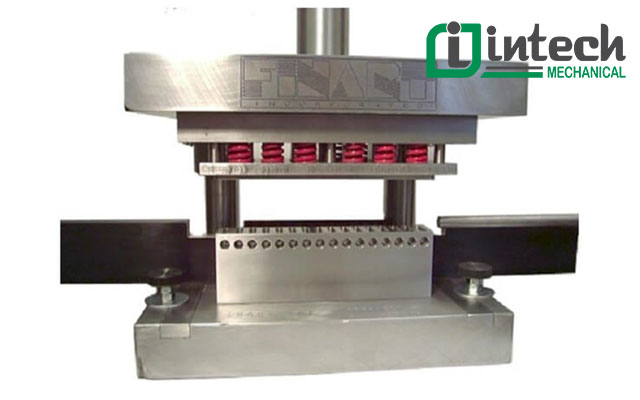
Structure of a stamping die
- A stamping die consists of two main components:
- Upper die (punch): The upper part of the die, attached to the ram (or hammer), which moves up and down to exert pressure on the workpiece.
- Lower die (die block): The lower part of the die, which remains stationary.
Classification of stamping dies
- Based on the type of punching operation, there are two types of dies:
-
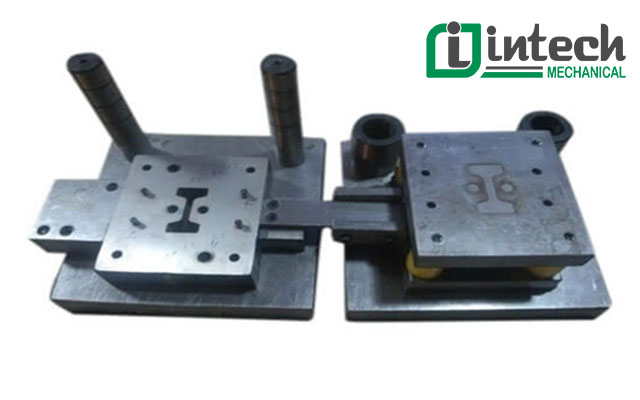
Cutting die: This type of die is used to cut metal, performing punching and cutting operations.
-
Stamping die: This type of die alters the shape of the workpiece without removing any material.
- Based on the punching method:
- Simple stamping die: A die that performs a single operation per stroke. It is used exclusively for cutting operations. A limitation of this type is that when punching large diameters, the resulting hole may become distorted or uneven.
- Compound stamping die: A die that performs two or more operations simultaneously in a single stage (specifically cutting operations). Since all tasks are executed at once, the parts achieve high precision. However, this type is limited to relatively simple processes.
- Combination stamping die: A die that performs two or more forming operations during a single press stroke; all operations occur simultaneously, and the product is fully formed upon exiting the die.
- Progressive stamping die: A die where a specific operation is performed at each stage. After a stage is completed, the workpiece advances to the next stage in the line. The part is partially formed at each position, reaching its final, complete form at the last station. A progressive die can be viewed as a complete production cycle.
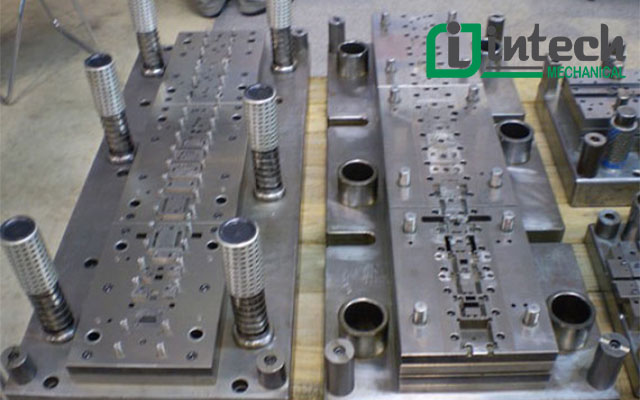
Quality standards for progressive die manufacturing
- Stamping dies must be manufactured to ensure high wear resistance.
- The die must possess hardness and toughness characteristics appropriate for its specific function (e.g., a punching die requires lower hardness than a deep-drawing die).
- The die material must be compatible with the material of the stamped product and the required production volume.
- Proper lubrication must be ensured during the stamping process.
Mechanical requirements, such as strength, hardness, and wear resistance, are the key characteristics that determine the die's performance and extend its service life.
Applications of stamping dies
Stamping dies are used in various manufacturing sectors, such as:
- Home appliances (food cans, bowls, pots, sinks, etc.)
- Automotive (car bodies, doors, and various other components)
- Construction (structural steel, door reinforcements, etc.)
- Electronics
- HVAC (Heating, Ventilation, and Air Conditioning)
- Medical (medical instruments)
- Plumbing systems
- Power tools
- Military (firearms, ammunition, weaponry)
Stamping die materials
The material used for stamping dies significantly impacts their quality and service life. Common steels used for this purpose include:
- SKS3: Offers highly stable hardness after heat treatment and excellent cutting and stamping performance; minimizes die deformation following heat treatment.
- SKS93: A high-carbon steel suitable for low-volume production; easy to machine and heat-treat (oil-hardening).
- SKD11: A stamping die steel offering high wear resistance at ambient temperatures. Good hardenability and minimal quenching stress enhance hardness and surface quality while reducing warping during processing.
- DC53: Features excellent wear resistance and minimal deformation after heat treatment; offers better machinability and weldability compared to SKD11.
Design and manufacturing process for stamping dies
Step 1: Calculate the required punching/shearing force after receiving the sample product from the partner. This force is generated by the press machine acting upon the die assembly, creating significant external pressure. The magnitude of the shearing force can be adjusted. Calculating the force required for the punch to engage the die serves as the foundation for the subsequent steps.
Incorrect calculation of the punching force can lead to two types of issues:
- First, excessive force causes the metal surface at the cutting point to warp, crack, or deform.
- Second, insufficient downward force fails to cut through and remove the workpiece material.
Step 2: Select a stamping press with a capacity suitable for the mold you intend to design. Ideally, choose a stamping provider that utilizes modern technology; this will greatly benefit your sheet metal stamping project.
Step 3: Calculate the dimensions and height of the mold and its specific components. These specifications will be represented using professional design software.
Step 4: Proceed with the metal stamping die design using software.
Various design software options are available; the specific choice depends on the design firm and what best suits their capabilities and experience. Both 2D and 3D design software can be used to create visual simulations of the die and the part to be stamped.
Step 5: Proceed with fabrication according to the design drawings.
Step 6: Check the assembly.
Step 7: Test the mold
Step 8: Evaluate the results (address any issues that arise).
Intech Mechanical offers fast and precise custom stamping die manufacturing.
Intech is a leading mechanical machining company in Vietnam, boasting years of experience in precision machining and manufacturing. We utilize modern machinery and software systems to ensure exceptional product accuracy. Our molds and stamping dies are designed and manufactured to deliver optimal quality and high precision at competitive prices.
Our team of highly qualified technical experts is ready to provide consultation and support, helping clients identify the most suitable solutions for their businesses. Please contact Intech Mechanical for a quotation:
