


-

Stamping die manufacturing
A stamping die is a tool used in the stamping process; it serves to shape products from thin metal sheets at room temperature through the application of pressure.
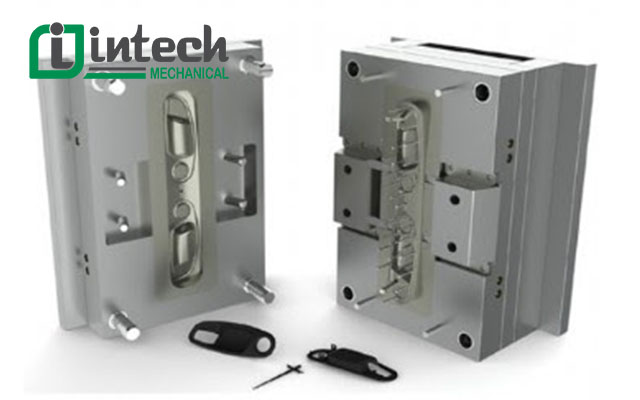
A mold (also referred to as tooling) is the core of the injection molding process. Molds are machined and shaped based on the desired product geometry. The injected plastic product takes its final shape through the structure and geometry of the mold cavity (also known as the mold core or insert).
A mold consists of two main parts, commonly referred to as the male mold and female mold. In technical terminology and industrial manufacturing plants, it is divided into two sections: the stationary side (fixed half) and the moving side (movable half).
Custom mold machining services based on technical drawings and specific requirements serve as an optimal solution, enabling manufacturing businesses to maintain production flexibility, optimize investment costs, and enhance their market competitiveness.
What is mold manufacturing?
Mold manufacturing is the process of designing and fabricating metal molds (made from materials such as steel or aluminum) to shape industrial products in mass quantities. This method integrates engineering design, machining programming, and modern technologies—such as CNC machining, wire-cut EDM, and sinker EDM. Once completed, the molds are installed in pressing, stamping, or casting production lines to manufacture products that meet precise shape and dimensional specifications.
- The role of molds in industrial production:
- Ensuring consistency: Molds enable the mass production of items with uniform dimensions, shapes, and quality, while minimizing deviations.
- Boosting productivity: They facilitate the automation or optimization of high-speed product forming processes, meeting the demands of large-scale production.
- Optimizing costs: Although the initial investment in mold fabrication is substantial, the cost per unit decreases significantly during high-volume production.
Common types of molds today
Each industry and material type requires different specialized types of molds:
- Plastic injection mold manufacturing:
It is widely used in the manufacture of electronic device housings, automotive components, household appliances, medical equipment, and engineering plastic parts that require high dimensional precision and aesthetic appeal.
- Metal stamping die manufacturing
Used for cutting, punching, bending, or shaping sheet metal. This type of die is extremely common in the automotive, motorcycle, electronic component, and mechanical manufacturing industries.
- Mold manufacturing
Supports pressure die-casting processes (using aluminum, zinc, or alloys) or other metal casting methods to produce castings with complex shapes and robust structures.
- Manufacturing of injection molds and compression molds
It is specifically applied in the molding of rubber, thermosetting plastics, and certain specialized materials that require both pressure and heat during the vulcanization process.
- Blow mold manufacturing
Specially designed for the production of hollow plastic products, such as bottles, jars, and liquid containers—as well as molded plastic packaging.
Common mold manufacturing methods
To manufacture a complete mold assembly, workshops typically employ a combination of advanced machining technologies:
- CNC Milling: The primary method for shaping mold cavities, cores, parting lines, and complex 3D surfaces with high precision and high cutting speeds.
- CNC Turning: Used to machine rotationally symmetrical mold components, such as guide bushings, locating pins, shafts, and cylindrical parts.
- Wire-cut EDM: Uses an electrical discharge via a cutting wire to machine sharp corners, narrow slots, deep grooves, or complex shapes inaccessible to conventional milling cutters.
- Sinker EDM: Uses an electrode (typically copper or graphite) to discharge electricity and shape deep cavities, tight corners, and intricate details in heat-treated, high-hardness materials.
- Grinding and Polishing: Surface finishing processes designed to achieve flatness, mirror-like finishes (for plastic mold cavities requiring high aesthetic quality), and ultra-precise dimensional tolerances.
- Benchwork, Assembly, and Adjustment: Skilled technicians perform manual grinding, fitting (matching mating surfaces), assembling sliding systems and ejection mechanisms, and verifying the mold's fit and alignment.
The choice of machining method depends on the workpiece material, hardness, part geometry, required tolerances, and surface specifications of each mold component.
Materials commonly used in mold making
Mold materials play a decisive role in durability, the number of molding or stamping cycles, and product quality:
- Mold-making steels:
- Plastic mold steels: Typically involve grades with good polishability and wear resistance, such as P20, NAK80, and H13, depending on production volume requirements.
- Cold-work mold steels: Require high toughness and wear resistance, such as SKD11 and DC53.
- Hot-work mold steels: Require the ability to maintain hardness at high temperatures, such as H13 and 2344 steels.
- Aluminum alloys: Typically used for prototype molds ("soft tooling"), short-run molds, or applications requiring reduced weight and shorter lead times for blank fabrication.
- Copper alloys and specialized materials: Beryllium copper (CuBe) is commonly used for EDM electrodes or in areas of injection molds requiring rapid heat dissipation; other non-metallic materials or specialized alloys are employed to meet specific technical requirements.
* Material selection criteria: The choice of material grade and heat treatment process must be based on the mold's actual function (load, temperature, plastic chemical properties, and projected production volume) to achieve an optimal balance between mold lifespan and investment cost.
Precision mold manufacturing process
The mold manufacturing process involves multiple steps; outlined below are six fundamental steps:
1 - CAD
Product Design:
Product designs may be provided by the customer or created in-house; CAD is used to perform the following tasks:
- Designing product profiles and geometric shapes using 3D modeling.
- Conducting technical analysis of the product or component (e.g., fillet radii, draft angles, wall thickness).
- Generating technical drawings.
Mold Design:

- Project and order specifications: Component design, quantities, and product materials.
- Injection molding machine specifications: Injection pressure, clamping force, shot capacity, and platen dimensions.
- Mold type.
- Shrinkage: Determination based on material properties and wall thickness.
- Mold materials: Material type for each component and hardness.
- Cavity and core (female and male mold parts): Monolithic or assembled construction.
- Cavity layout: Number of cavities, arrangement, and positioning.
- Runner cross-section: Circular, semi-circular, trapezoidal, or hot runner.
- Gating system: Diaphragm, ring, edge, submarine (tunnel) gate, gate location, etc.
- Ejection system: Ejector pins, ejector plates, ejector sleeves.
- Guiding and alignment: Tapered alignment, guide pins, locating rings.
- Venting system design and layout.
- Generation of drawings or design files.
2 - CAE

CAE (Computer-Aided Engineering) involves the use of computer software to simulate and test the manufacturability and characteristics of a product after the design phase. It offers significant benefits for subsequent machining and production processes, enabling designers and mold makers to reduce both design time and mold manufacturing costs.
Purpose of using CAE:
- Analyze the flow of molten plastic (the mold-filling process).
- Analyze the solidification and product-shaping processes within the mold cavity.
- Calculate filling dynamics and heat dissipation to identify potential product defects.
- These analyses help determine the optimal gate location; consequently, CAE analysis is applied to optimize the design through simulation and calculation.
- Once the gate location, runner system, and cooling system designs are finalized, the venting system is designed using CAE software.
- Utilizing CAE analysis for these design steps minimizes manufacturing waste and reduces the likelihood of defects to the lowest possible level.
- These analyses help determine the optimal gate location.
3 - CAM

CAM stands for Computer-Aided Manufacturing. The manufacturing process is managed and controlled by a computer system.
CAM performs the following tasks:
- The first step is to establish the mold manufacturing process based on the product.
- Analyze the costs associated with the manufacturing process.
- Based on this analysis, select appropriate materials for both the mold and the product.
- Select the type of machine and the necessary parameters for the molding process.
4 - CNC Machining
This is the stage where CNC machining equipment and cutting tools are used to cut and shape metal into molds, following the technology programmed via CAM.
Example: Mold Machining Cycle

5 - Mold polishing and assembly
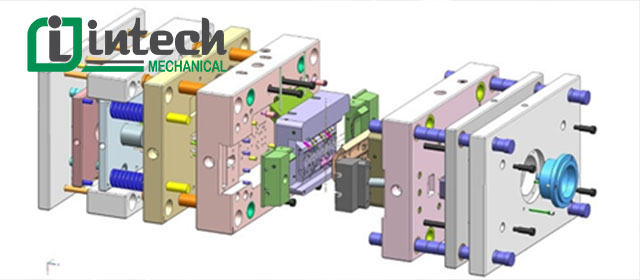
- Step 1: Thoroughly clean the interior and exterior of the mold. Pay special attention to polishing the mold cavity; improper polishing can lead to defects during trial runs.
- Step 2: Inspect and remove any burrs from the components before assembly to prevent scratching the finished product.
- Step 3: Gather all mold components and their corresponding detailed drawings.
- Step 4: Assemble the mold according to the assembly drawings.
- Step 5: Inspect the quality of the fully assembled mold and conduct a trial run.
The complete fabrication of molds, from the mold base to individual components, is often a highly time-consuming process, with the duration depending on the mold's complexity. Even a seemingly simple step like surface polishing or texturing requires meticulous attention; over-polishing, for instance, can ruin the component.
6 - Mold Test ( Trial pile driving)

Conduct a final inspection of the product; if it meets requirements, proceed with delivery; otherwise, redesign the product.
Technical requirements for precision mold manufacturing
To ensure stable mold operation and extend service life, the following technical standards must be strictly controlled:
- Dimensional accuracy and tolerances: Ensure mating parts fit perfectly, preventing mechanism jamming or misalignment.
- Surface smoothness and quality: Particularly critical for plastic mold cavities to prevent product adhesion and ensure the required aesthetic gloss.
- Hardness and wear resistance: Capable of withstanding continuous operation cycles producing tens of thousands to millions of units without deformation.
- Concentricity, flatness, and parallelism: Ensure geometric precision for mating working surfaces.
- Operational stability: Minimize flash, mold misalignment, and product jamming during mass production.
Applications of mold manufacturing services
- Automotive and motorcycle industry: Manufacturing stamping dies for vehicle bodies and injection molds for interior/exterior plastic parts and dashboards.
- Electronics and home appliance industry: Producing casings for TVs, refrigerators, and washing machines; electronic component connectors; and mobile phone housings.
- Packaging and plastic products industry: Injection molds for bottle caps and plastic crates; blow molds for plastic jerrycans and water containers.
- Mechanical engineering and supporting industries: Stamping dies for technical components and aluminum casting molds for machinery parts.
- Product Research and Development (R&D): Manufacturing prototype molds for testing before committing to large-scale mass production.
Custom mold manufacturing service at Intech Mechanical
Intech Mechanical provides professional mold manufacturing solutions designed to meet the diverse and rigorous technical requirements of industrial manufacturing enterprises:
- Custom manufacturing based on drawings: Design and fabrication of plastic injection molds, stamping dies, and casting molds based on client-provided 2D/3D drawings.
- Optimization consulting: Assistance with product structure analysis, selection of appropriate mold steel grades, and determination of optimal machining methods to maximize cost-efficiency and mold lifespan.
- Strict quality control: Utilization of precision machining equipment combined with rigorous inspection processes at every stage of production.
- Schedule adherence and technical support: Guaranteed on-time delivery, alongside support for adjustments, mold testing, and periodic maintenance.
Contact Intech Mechanical today to have our technical team evaluate your drawings, advise on optimal manufacturing solutions, and provide a detailed quotation tailored to your business's specific needs.
Contact information:
- Phone: 0966 966 205
- Email: cokhichinhxac@intech-group.vn
- Address: Lot 6, Lai Xa Industrial Cluster, Tay Tuu Ward, Hanoi City
