


Mechanical Component Machining: Processes, Methods, and Reputable Custom Services
13-10-2026 6
Mechanical component machining is one of the most critical foundations of the manufacturing, machinery production, and automation industries. To create machines that operate smoothly, precisely, and reliably, every single component must undergo a meticulous machining process.
Mục lục
What is mechanical component machining?
Mechanical component machining is the process of using technological methods such as cutting, material removal, and shaping to transform raw workpieces into components that meet the specific shape, dimensions, surface roughness, and mechanical properties required by technical design drawings.
The purpose of mechanical component machining
- Product shaping: Transforming raw materials into the intended 2D or 3D forms.
- Achieving required dimensions and tolerances: Ensuring precise interchangeability between components.
- Ensuring assembly integrity: Enabling smooth mechanism operation without binding or excessive play.
- Meeting technical specifications: Achieving high precision, low surface roughness, and mechanical durability under operating loads.
Common mechanical components
In manufacturing practice, engineers frequently work with the following groups of components:
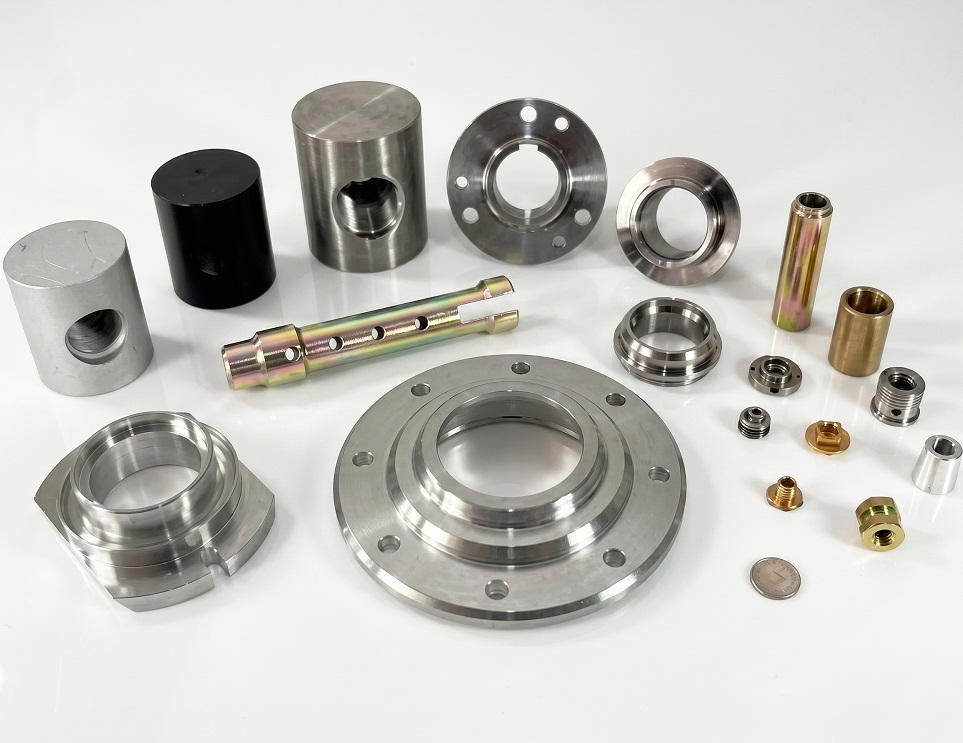
- Shafts, bushings, and pins: Components for transmitting rotary motion and positioning.
- Couplings, flanges, and bearing supports: Components for connecting and supporting shafts.
- Gears, pulleys, rollers, and sprockets: Components for transmitting power and speed.
- Mounting plates, jigs, housings, and structural parts: Frameworks, casings, and assembly aids.
What stages are involved in the machining of mechanical parts?
A standard precision mechanical machining process involves the following sequential steps:
1. Receipt of drawings and technical specifications
The technical department reviews 2D/3D drawings to clearly define:
- Nominal dimensions and permissible limits.
- Dimensional and geometric tolerances (form and position).
- Surface roughness (Ra, Rz).
- Manufacturing materials and associated heat treatment or surface treatment requirements.
- Order quantity and delivery schedule.
2. Analysis of the machining strategy
- Selecting the optimal CNC machining method for the mechanical part.
- Choosing the appropriate machine type, cutting tools, and specialized fixtures.
- Establishing a logical sequence of operations and process steps.
- Determining positioning datums (rough and finish datums) to minimize setup errors.
3. Material preparation
Selecting the correct type of raw material (workpiece): Carbon steel, stainless steel, aluminum, copper, cast iron, engineering plastics, or special alloys. Checking raw material dimensions to ensure an appropriate machining allowance.
4. Machining and shaping
Utilizing modern technologies for material removal: Turning, milling, drilling, reaming, tapping, grinding, laser cutting, bending, wire-cut EDM, or CNC machining centers.
5. Post-machining processing
To enhance the mechanical properties and aesthetics of the machined components:
- Heat treatment (hardening, carburizing, annealing, tempering).
- Electroplating, galvanizing, chrome plating.
- Anodizing (for aluminum), powder coating, polishing, sandblasting, and anti-rust treatment. 6. Quality Control (QC)
Rigorous inspection of dimensions, tolerances, surface roughness, threads, concentricity, run-out, etc., using specialized measuring instruments: calipers, micrometers, dial indicators, and 3D coordinate measuring machines (CMM).
7. Packaging and Delivery
Removal of oil and grease, application of anti-rust grease (if required), packaging in accordance with technical standards, and delivery of the correct quantity on schedule.
Common methods for machining mechanical components
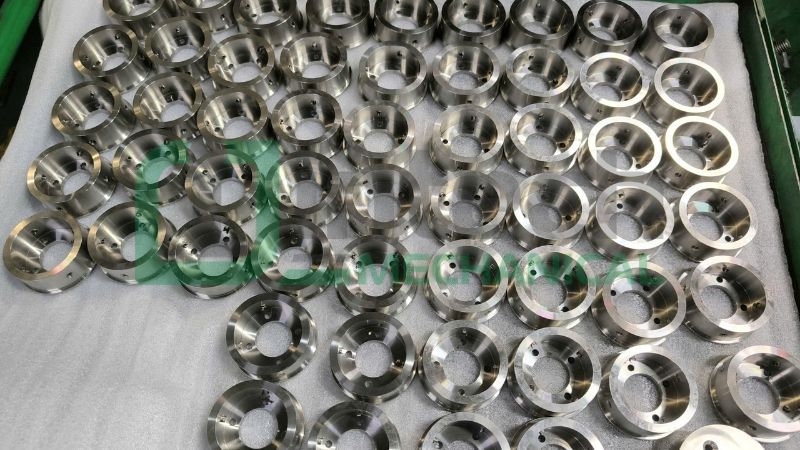
1. Turning
- Principle: The workpiece rotates about its axis while the cutting tool (turning tool) moves longitudinally or transversely to remove material, creating surfaces of revolution.
- Suitable components: Drive shafts, bushings, pins, threaded parts, and components featuring conical surfaces, external cylindrical surfaces, or internal bores.
- Classification: Conventional (general-purpose) turning and CNC turning (highly automated, offering micron-level precision).
2. Milling
- Principle: A milling cutter rotates at high speed to perform the cutting, while the workpiece is clamped securely to the machine table and moves along the X, Y, and Z axes.
- Applications: Machining flat surfaces, slots, steps, and gears, as well as complex 3D profiles.
- Classification: Conventional milling and CNC milling (including 3-axis, 4-axis, and 5-axis machines for extremely high precision).
3. Drilling – Boring – Tapping
This is a group of methods specifically used for machining hole-type features:
- Drilling: Creating a new hole from a solid workpiece.
- Counterboring / Reaming: Enlarging the hole and improving the dimensional accuracy and surface finish of its interior.
- Tapping: Cutting internal threads within the hole to accommodate bolts or screws.
4. Grinding process
- Principle: A grinding wheel rotating at very high speed is used to remove an extremely thin layer of material from the workpiece surface.
- Classification: Surface grinding, cylindrical grinding, and internal grinding.
- Application: Grinding is typically the final finishing process when a workpiece requires strict dimensional accuracy (high precision grade) and very low surface roughness (a smooth, polished finish).
5. Wire-cut EDM machining
- Principle: Uses a continuously moving metal wire (typically brass) to cut material via electrical discharges (spark erosion).
- Applications: Cutting complex profiles, narrow slots, and sharp, square corners, or machining mold components made from heat-treated (hardened) materials that cannot be processed using conventional milling cutters..
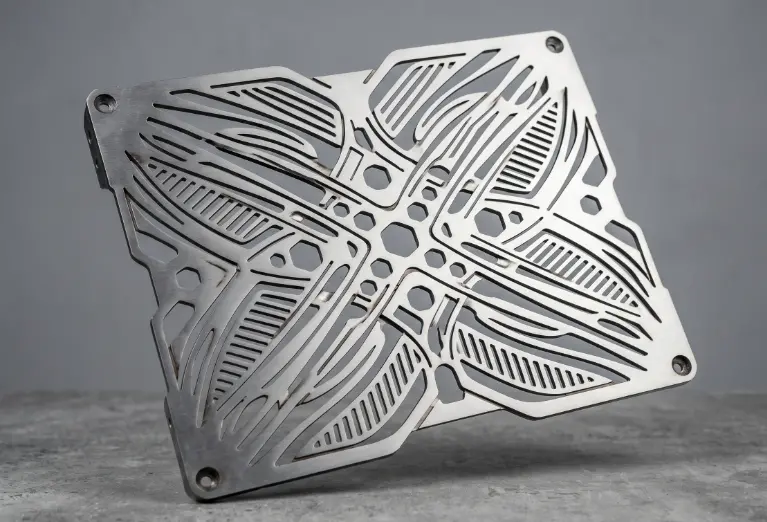
6. Laser cutting processing
- Principle: A high-energy laser beam is focused onto the metal surface to melt or vaporize the material according to a digital design.
- Applications: Specialized for high-speed cutting of sheet metal (steel, stainless steel, aluminum) with clean, burr-free edges, optimizing initial part production time.
Quick summary table of application methods:
| Method | Key Equipment | Typical Applications |
| Turning | CNC lathe / Conventional lathe | Round parts, shafts, bushings, threads, tapers |
| Milling | CNC milling machine / Universal milling machine | Flat surfaces, slots, pockets, complex profiles, jigs/fixtures |
| Drilling/Boring/Tapping | Drilling machines, milling machines, machining centers | Hole making, internal threading |
| Grinding | Surface and cylindrical grinders | Surface finishing; achieving high gloss and tight tolerances |
| Wire-cut EDM | CNC wire-cut machine | Complex profiles, narrow slots, molds |
| Cắt Laser | Sheet Laser Cutting Machine | Rapid Sheet Metal Part Processing |
Types of mechanical parts commonly accepted for machining
- Shaft-type components: Drive shafts, roller shafts, conveyor shafts, industrial machinery shafts.
- Bushing-type components: Sliding bushings, guide bushings, bronze bushings, wear-resistant stainless steel bushings.
- Plate-type components: Mounting plates, support plates, connecting plates, protective covers.
- Block-type components: Bearing housings, aluminum/steel blocks, machine bases, gearbox housings.
- Transmission components: Spur gears, bevel gears, belt pulleys, sprockets, flexible couplings.
- Custom-engineered components: Parts with tight tolerances (precision fits), complex multi-hole parts, parts requiring specialized heat treatment.
Materials used in the machining of mechanical components
| Material Type | Common Grades | Key Characteristics & Applications |
| Steel | SS400, S45C, SCM440, SKD61, SKD11 | High durability, good bearing capacity, used for shafts, gears, molds. |
| Inox | SUS304, SUS316, SUS201 | Excellent corrosion resistance; used in the food, medical, and chemical industries. |
| Aluminum | Aluminum 6061, 7075 | Lightweight, good heat dissipation, easy to machine; used in automation and jigs. |
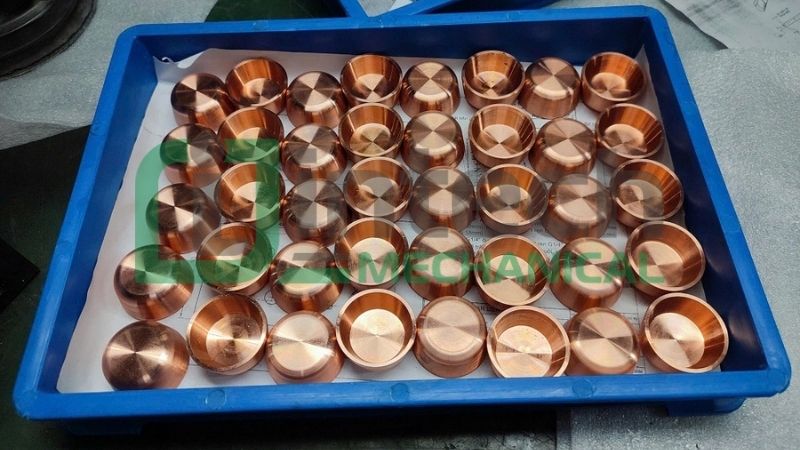
| Copper | Brass, red copper | Offers good electrical and thermal conductivity and high wear resistance; specialized for use in bushings and connectors. |
| Cast iron | Gray cast iron, ductile cast iron | Offers excellent vibration absorption; used for machine bodies and heavy-duty machine bases. |
| Engineering plastics | POM, PA, UHMW-PE, PTFE | Lightweight, low coefficient of friction, wear-resistant, good electrical insulation. |
Machining of mechanical parts according to drawings
1. Necessary information on technical drawings
To ensure the smooth machining of mechanical components, the drawing must clearly specify:
- Nominal dimensions and tolerance limits.
- Specific manufacturing material.
- Surface roughness (Ra, Rz).
- Thread standards (if applicable).
- Heat treatment requirements (hardening, carburizing, etc.) and surface treatment.
2. Commonly used drawing formats
- 2D drawings: .PDF, .DWG, .DXF (AutoCAD) formats.
- 3D model: .STEP / .STP, .IGES / .IGS format, design files from SolidWorks, Inventor.
3. Cases where the customer does not yet have a drawing
If the customer only has a physical sample, images with manual measurements, or a 3D model concept, the technical team will assist with measuring, designing, and creating a complete set of drawings prior to fabrication.
4. Quotation process based on drawings
Receive drawings --> Technical analysis --> Select materials & methods --> Calculate lead time --> Quote --> Prototype production (if required) --> Mass production.
Standard 8-step mechanical part machining process
- Step 1: Receive requests and information from the customer.
- Step 2: Thoroughly review drawings and specific technical requirements.
- Step 3: Advise on optimal materials and the most cost-effective machining methods.
- Step 4: Develop the manufacturing process and create CAM machining programs.
- Step 5: Prepare raw material blanks, machinery, cutting tools, and fixtures.
- Step 6: Perform machining on CNC or conventional machine systems.
- Step 7: Inspect the quality of the finished product via an independent QC system.
- Step 8: Perform surface finishing, ensure secure packaging, and deliver to the customer.
Factors determining the quality of mechanical parts
- Machining accuracy: Modern CNC machines offering high rigidity and excellent spindle stability.
- Technician expertise: Proficiency in blueprint reading and programming, along with experience in managing thermal deviations and workpiece deformation.
- Materials and workpieces: Correct material grades, transparent origins, and freedom from internal impurities.
- Cutting tools: Appropriate tool selection, high sharpness, and optimized cutting parameters to ensure a smooth, glossy finish.
- Fixtures and positioning methods: Ensuring absolute workpiece stability and eliminating vibration during the cutting process.
- Quality Control (QC): Rigorous cross-verification throughout the machining process and during final inspection.
Tolerances and precision in mechanical component machining
- Dimensional tolerance: The allowable range of variation between limit dimensions (e.g., a shaft diameter of Ø50 ±0.05 mm, ranging from 49.95 mm to 50.05 mm) to ensure precise assembly.
- Geometric Dimensioning and Tolerancing (GD&T): Controls surface characteristics such as flatness, parallelism, perpendicularity, concentricity, and runout.
- Surface roughness (Ra): Defines surface smoothness; it determines oil retention, wear resistance, and sealing integrity upon assembly.
- Core principle: Tolerances must be selected based on actual functional requirements. Avoid tolerances that are too loose (leading to looseness or failure) or too tight (significantly increasing machining costs and time).
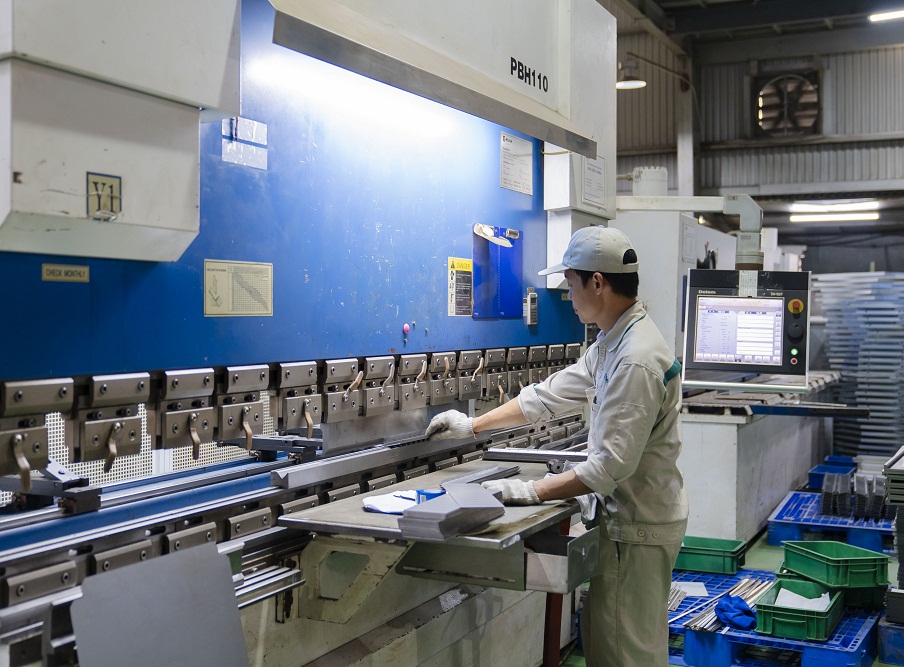
Machinery systems used in mechanical processing
| Machine Name | Primary Workshop Application |
| CNC Lathe | Machining of rotational parts, shafts, bushings, and external/internal threads. |
| CNC Milling Machine | Machining of flat surfaces, slots, pockets, and complex 3D profiles. |
| Conventional Lathe | Machining of simple parts and rapid part repair. |
| Conventional Milling Machine | General-purpose universal machining. |
| Grinding machine | Achieves a high-gloss surface finish and ultra-precise dimensions. |
| Laser cutting machine | Rapid cutting of sheet metal blanks with sharp, clean edges. |
| Wire-cut EDM machine | Cuts complex profiles, narrow slots, and ultra-hard materials. |
| CMM (Coordinate Measuring Machine) | Performs automated 3D dimensional inspection with absolute precision. |
Applications of mechanical component machining in industries
- Conveyor industry: Manufacturing shafts, pulleys, rollers, brackets, and drive sprockets.
- Automation industry: Fabricating jigs, precision drive mechanisms, and specialized machine components.
- Automotive & Motorcycle industry: Machining components for engines, gearboxes, and powertrains.
- Electrical & Electronics industry: Manufacturing component testing jigs and circuit board assembly fixtures.
- Food & Pharmaceutical industries: Machining polished stainless steel parts that meet strict hygiene and safety standards.
- Mold & Die industry: Manufacturing mold inserts, injection molding plates, and stamping dies.
- Packaging industry: Supplying shafts, rollers, and gears for packaging lines.
Machining of mechanical parts, from small to large quantities.
- Single-unit machining: Suitable for prototyping, repairing or replacing damaged components, or creating original machinery designs.
- Small-batch machining: Allows for easy design modifications and improvements during product testing.
- Batch machining: Optimizes productivity, reduces machine setup time, and utilizes specialized fixtures to lower costs.
- Mass production machining: Features high levels of automation, ensures consistent quality across tens of thousands of products, and maximizes cost-efficiency per unit.
What factors determine the price quote for mechanical component machining?
Machining service costs are directly influenced by the following factors:
- Material type and initial workpiece dimensions.
- Finished product dimensions and profile complexity.
- Technical tolerance and surface roughness requirements.
- Machining method employed and total machine runtime.
- Order quantity (higher volumes result in lower unit prices).
- Ancillary requirements: heat treatment, surface plating, special inspections, and expedited delivery.
How to optimize machining costs for mechanical parts
- Design details for manufacturability: Minimize blind spots and excessively deep cavities; avoid overly tight tolerances unless strictly necessary; and specify corner radii that match standard cutting tool sizes.
- Select appropriate materials: Choose common, readily available, and easy-to-machine material grades rather than rare ones, unless required.
- Optimize order quantities: Consolidate orders into larger batches rather than placing multiple small, sporadic orders to save on machine setup costs.
- Standardize dimensions and materials: Minimize the variety of materials used within a single assembly.
- Provide complete drawings: Supply clear technical information upfront to enable the workshop to quickly determine the optimal toolpath strategy.
Custom mechanical component machining services in Hanoi
If your business is seeking a reputable, high-quality mechanical machining provider that ensures on-time delivery, Intech Mechanical is the premier choice capable of meeting even the most rigorous requirements.
Intech Mechanical offers comprehensive custom fabrication services:
- Machine parts, high precision CNC parts.
- Shafts, bushings, pulleys, rollers, sprockets of all kinds.
- Jigs, assembly jigs, specialized jig plates.
- Processing a variety of materials: Steel, Stainless Steel, Aluminum, Copper, Technical Plastic...
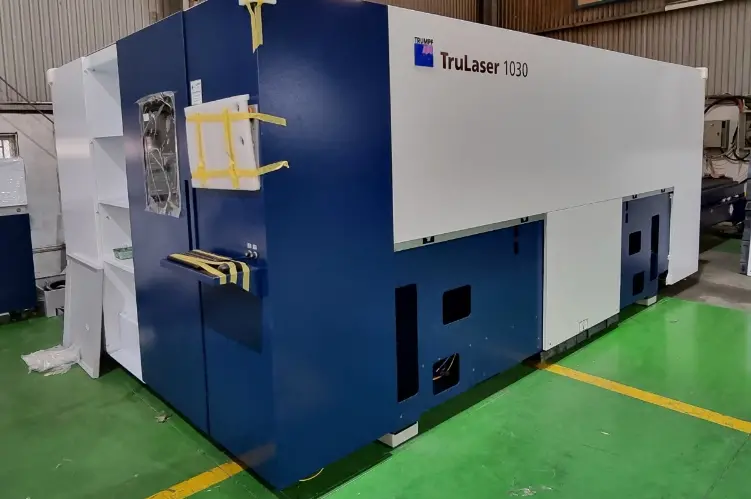
TRUMPF TruLaser 1030 2D laser cutting machine
- Intech's capabilities and service commitment:
- Superior Capabilities: State-of-the-art CNC turning and milling systems, high-power laser cutting machines, and a team of highly experienced mechanical engineers.
- Quality Commitment: Products manufactured with 100% adherence to blueprints, featuring rigorous quality control at every stage of production.
- Transparent Scheduling: Guaranteed on-time delivery and expert consultation on cost-optimized machining solutions.
- Flexible Production Volumes: Capable of handling everything from single-unit prototype orders to large-scale mass production.
To maximize investment efficiency, customers should select the appropriate machining method, standardize tolerances, and partner with reputable providers like Intech Mechanical to ensure the perfect balance of precision, quality, turnaround time, and cost.
Submit your 2D/3D drawings or project details via our system today to receive a free technical consultation and a rapid machining quote!
- Hotline: 0966 966 205 - 0988 365 586
- Email: cokhichinhxac@intech-group.vn
- Address: Lot 6, Lai Xa Industrial Cluster, Tay Tuu Ward, Hanoi City
