


Machine components are small yet crucial elements that make up a complete, modern machinery system. The machining of these components has evolved alongside advancements in science and technology; therefore, achieving professional improvements in machining methods requires upgrading the technological processes involved.
What is machine part machining?
Machine part machining is the process of shaping raw stock into finished components with precise dimensions and structural specifications. Surface processing is the most critical stage of this operation, as it demands meticulous attention to detail to ensure a smooth, durable, and high-quality finish.
Even when using the same raw material, different processing methods and parameters yield finished products with varying surface qualities and functional characteristics. Surface quality is evaluated based on geometric attributes, such as roughness, waviness, and dimensional deviations, as well as physicochemical properties, including hardness, residual stress, and surface layer microstructure.
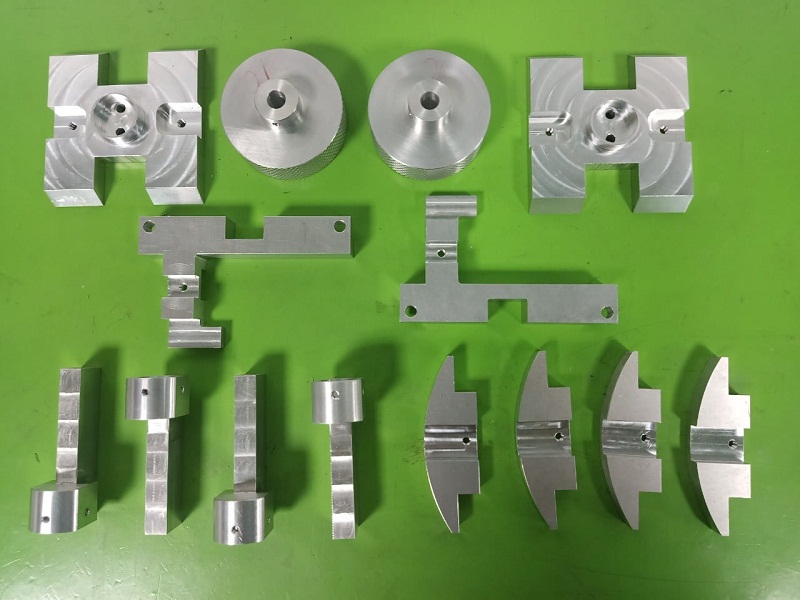 |
For example, the types of machine parts that are often machined
- Shafts, bearings, gears: Core transmission parts in gear boxes and motors.
- Pulley, sprocket: Used in belt and chain drive systems.
- Flange, coupling: Used to connect pipes or connect the motor shaft to the load.
- Bearings and rollers: Support the rotating shafts and support guidance in the conveyor belt.
- Guide bar: Positions and guides the machine table's forward motion.
- Fixing plates, jigs: Fix workpieces or tools during machining and assembly.
- Machine case and cover: The pedestal frame protects and shields the internal mechanisms.
- Details according to separate drawings: Processing according to exclusive customer orders.
Materials commonly used in the machining of machine parts
Selecting the right material is crucial for determining the durability and functionality of machine components:
- Ferrous metals: Alloy steels and carbon steels (such as S45C, SKD11, SKD61, and SCM440) are notable for their high mechanical strength and excellent wear resistance, making them ideal for molds, shafts, and load-bearing gears. Cast iron is also widely used due to its superior vibration-damping properties.
- Non-ferrous metals: Aluminum alloys (A6061, A7075) are lightweight, corrosion-resistant, and easy to machine, making them suitable for the aerospace industry and electronic components. Copper and copper alloys (such as brass and bronze) are commonly used for friction-prone parts, bushings, and valves.
- Non-metallic materials: High-performance engineering plastics, such as POM, Nylon, Teflon (PTFE), and Bakelite are utilized for noise-reducing gears, guide rails, and components requiring electrical insulation or chemical resistance.
Why is precision machining of machine parts necessary?
1. Ensure assembly capability
- Dimensions and tolerances directly affect the fit between components.
- Minimizing misalignment, binding, or looseness facilitates a smooth and rapid assembly process.
2. Ensuring optimal machine performance
- High-precision components facilitate smooth, stable operation and enable the machine to achieve its maximum design capacity.
- Significantly reduces vibration, unpleasant noise, and mechanical friction losses during operation.
3. Enhancing equipment durability and lifespan
- Strict control over materials, geometric dimensions, and surface roughness ensures more even load distribution.
- Minimizes wear and material fatigue, thereby extending the service life of the entire piece of equipment.
4. Meeting specific production requirements
- Offers complete flexibility for machining based on specialized technical drawings.
- Ideally suited for manufacturing replacement parts, creating prototypes, and handling production runs ranging from single units to mass production.
Common methods for machining machine parts today
Advances in mechanical engineering technology have introduced numerous advanced machining methods that meet all stringent requirements regarding geometry and surface finish:
1. Turning
- Operating principle: The workpiece rotates about its axis, while the cutting tool moves linearly to remove excess material.
- Commonly turned parts: Shafts, bushings, pins, pulleys, and threaded components.
- Advantages of CNC turning: Extremely high geometric precision, smooth surface finish, and the ability to easily machine complex thread profiles with a high degree of automation.
2. Milling
- Milling principle: A rotating milling cutter performs the primary cutting motion, combined with the feed motion of the machine table (carrying the workpiece) along various axes.
- Applications: Milling of flat surfaces, keyways, steps, deep pockets, and complex curved profiles.
- Classification: 3-axis, 4-axis, and 5-axis CNC milling enable the machining of complex 3D geometries in a single setup.
3. Drilling and Tapping
- Drilling: Creating new holes in solid workpieces.
- Counterboring and reaming: Enlarging hole dimensions while improving dimensional accuracy and surface finish.
- Tapping: Cutting internal threads into hole walls to accommodate bolts and screws.
- Requirements: Strict adherence to hole center positioning accuracy and perpendicularity relative to the surface.
4. Grinding
- Classification: External cylindrical grinding, internal cylindrical grinding, and surface grinding.
- Role: A final finishing process to achieve high precision (tolerance grades 6 or 5) and ultra-low surface roughness (low Ra value); typically applied to parts that have undergone heat treatment for hardening.
5. Laser Cutting
- Applications: Cutting sheet metal (steel, stainless steel, aluminum) using a high-intensity laser beam.
- Advantages: Extremely high cutting speeds, sharp cut edges, burr-free results, minimal dimensional deviation, and flexibility to follow any 2D design.
6. CNC Bending
- Principle: Utilizing the hydraulic force of a press brake to bend sheet metal to the angles specified in the design drawings.
- Applications: Forming machine housings, electrical cabinet frames, equipment casings, and box-like structures.
- Classification: Wire EDM and Die-sinker EDM.
- Applications: Ideal for ultra-hard materials (such as hardened steel) and components featuring complex geometries, narrow slots, or sharp corners that are inaccessible via conventional milling or turning methods.
8. CNC Machining
- Concept: A computer-controlled machining technology that automates the entire tool-path process based on G-code programs generated from CAD/CAM files.
- Advantages: Exceptional precision, perfect repeatability across mass-produced parts, and minimal reliance on manual craftsmanship.
Application of machine component machining
- Automotive, motorcycle, and aerospace industries: Manufacturing crankshafts, connecting rods, transmission gears, and engine components requiring high fatigue strength.
- Automation and robotics: Producing joints, robotic arms, lead screws, and guide rails.
- Medical and energy sectors: Machining surgical instruments, artificial joints, and components for wind turbines or oil and gas equipment.
Precision machine component machining process
- Product design drawings: Review and study detailed drawings; understand the intended use, part classification, technical requirements, and manufacturing characteristics of the machine component.
- Determine the production type: Single-unit, batch, or mass production.
- Select the workpiece and manufacturing method: Choose a workpiece of appropriate dimensions and a suitable method for its production.
- Determine the sequence of steps and operations; select work-holding setups for each operation and define the machining methods.
- Select appropriate tools, equipment, and fixtures, as these factors determine product quality.
- Define machining methods for each stage and step of the process.
- Select suitable tooling for the required stages.
- Assign specific stages to skilled workers or technicians.
- Perform machining operations using equipment such as CNC machines.
- Inspect the quality of the finished product.
Custom machined parts service at Intech Mechanical
Intech Mechanical is a provider of high-quality, reasonably priced machined components. We manufacture parts, machinery components, and industrial and medical equipment, delivering superior quality at optimal costs.
- Service Strengths:
- Precision machining strictly adhering to technical drawings.
- Equipped with modern, state-of-the-art CNC machinery.
- Team of highly experienced engineers and machinists.
- Rigorous quality control (QC) processes at every stage.
- Prompt quotations and cost-optimized solutions.
- Guaranteed on-time delivery.
- Capable of handling orders ranging from small batches (or single units) to large-scale production.
- In-depth technical consultation provided before and after machining.
What is the cost of machining machine parts?
The cost of machining machine parts depends on the machining method, material type, and machine operating time. However, as a general guideline, prices typically range from 300,000 VND to several million VND for a simple part. Costs will be higher for more complex products or large-scale production runs.
To receive a detailed quote, please provide us with the following: 2D/3D technical drawings, CAD files (if available), material grade, production quantity, overall dimensions, critical tolerances, surface roughness specifications, heat treatment or surface finishing requirements, desired delivery date, and delivery location.
Selecting a reputable, professional machining partner is key to enhancing product quality. Please submit your requirements to us today to receive expert advice and the best possible quote.
