


What is a jig?
A jig is a device used to position a workpiece relative to the cutting tool and to securely hold it in place against cutting forces during machining. Jigs are essential auxiliary devices in the processes of mechanical machining, inspection, and the assembly of mechanical and electronic products.
Fixtures play a vital role in enhancing the level of mechanization and automation in precision mechanical manufacturing. Since the process of mounting and securing workpieces is essential for any machining operation, fixtures are indispensable technological equipment in metal-cutting processes. High-quality fixtures, capable of precise positioning and secure clamping, are required.
If your business is seeking solutions for designing and manufacturing fixtures based on technical drawings or specific operational requirements, partnering with a reputable company like Intech Mechanical, which possesses advanced precision machining capabilities, is a decisive factor in the success of your production line.
What is jig manufacturing?
Jig machining is the process of designing and manufacturing specialized auxiliary equipment to position, hold workpieces tightly and guide cutting tools on machine tools to ensure high accuracy in production.
This process requires the synchronous combination of many advanced technologies such as CNC milling, CNC turning, flat grinding, boring and drilling, EDM wire cutting, structural welding and precision mechanical assembly.
Structure of a jig
Jig designs may vary depending on the intended purpose and specific requirements; however, in general, a jig consists of the following basic components:
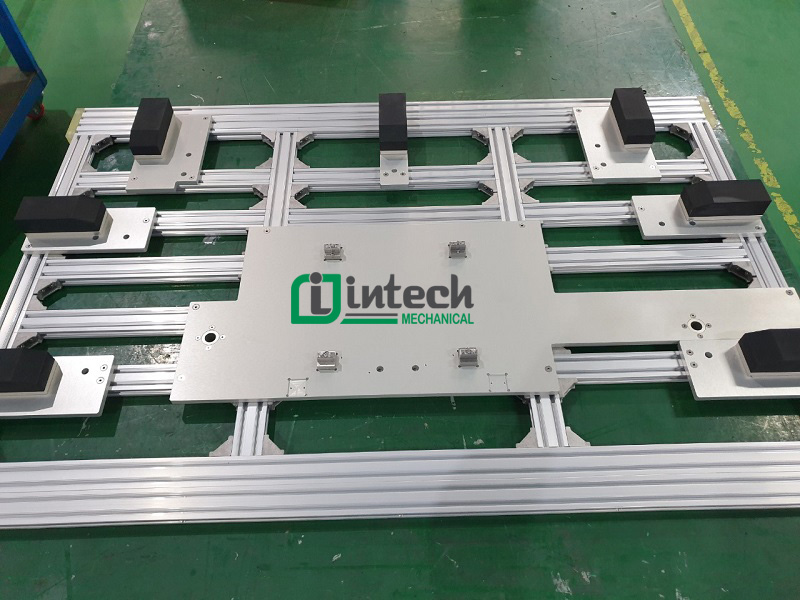 |
- Workpiece clamping unit
- Workpiece positioning unit
- Workpiece force transmission unit
- Workpiece rotation and indexing mechanism
- Fixture body
- Fixture body and base
Fixture machining technology and methods
To manufacture a fixture meeting rigorous technical standards, the workshop requires a diverse range of precision machining equipment:
- CNC Milling: Machining reference surfaces, locating slots, component cavities, and complex mating surfaces with high precision.
- CNC Turning: Producing shaft-like components, round locating pins, guide bushings, and sleeves with tight diameter tolerances.
- Drilling, Reaming, and Tapping: Creating threaded assembly holes and high-precision locating holes within the fixture body.
- Surface and Cylindrical Grinding: Finishing technical reference surfaces to ensure perfect parallelism, perpendicularity, and surface roughness.
- Laser Cutting, Wire-cut EDM, and Sinker EDM: Suitable for machining sheet components with complex profiles or tight internal corners that are difficult for milling cutters to access.
- Welding and Mechanical Assembly: Fabricating frames, bases, and heavy-duty welded structures, requiring strict control over post-weld deformation.
- Heat Treatment and Surface Finishing: Enhancing surface hardness and wear resistance through methods such as induction hardening, hard chrome plating, black oxide coating, or powder coating.
Common types of jigs and fixtures today
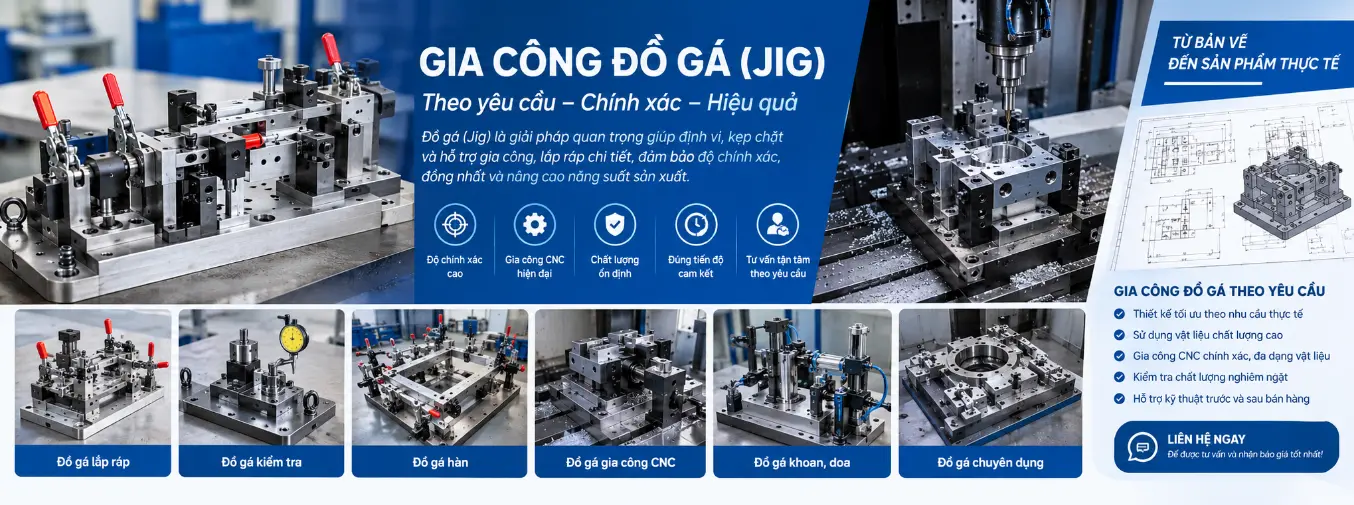
- Fabrication of assembly jigs
Assembly jigs are designed to position and hold individual components in their correct relative locations prior to joining operations—such as bolting, pressing, riveting, bonding, or welding—to form a complete assembly. These jigs are widely used in the manufacturing of electronic components and the assembly of automobiles, motorcycles, and industrial equipment.
- Fabrication of inspection fixtures
A check jig is a specialized device used to rapidly inspect geometric parameters, dimensions, hole positions, or the flatness/warpage of a product after machining. These jigs are often used in conjunction with dial indicators, limit switches, pin gauges, or optical measurement systems to provide an objective "Go/No-Go" assessment.
- Machining of welding jigs and fixtures
Welding fixtures serve to hold frame components, pipes, and steel plates in precise positions throughout the welding process. When designing and fabricating these fixtures, engineers must account for thermal deformation caused by welding heat, ensure accessibility for the welding torch, and maintain high structural rigidity.
- Fabrication of CNC machining fixtures
CNC machining fixtures (for milling, turning, and drilling) are mounted directly onto the CNC machine table to clamp and hold the workpiece. Key requirements for these fixtures include high rigidity to withstand strong cutting forces, evenly distributed clamping pressure that prevents workpiece deformation, easy chip evacuation, and exceptional positional repeatability during repeated loading and unloading of workpieces.
- Machining of drilling and reaming jigs
This is a traditional yet crucial type of jig for high-volume mechanical machining. When combined with a guide bushing system, the jig enables precise positioning of hole centers on the workpiece, eliminating the need for time-consuming manual marking or layout work on a general-purpose drilling machine.
- Machining of pressing and stamping jigs and component assembly fixtures
Suitable for operations requiring significant vertical force—such as pressing bushings into bearings, pressing shafts into gearboxes, positioning cold-stamped components, or performing assembly tasks within strict production line sequences.
Advantages of using jigs:
- Helps ensure product quality during machining, assembly, and inspection processes.
- Properly designed and accurate fixtures contribute to more precise specifications for machined products.
- Accurately positions and securely holds workpieces or blanks throughout the machining process, minimizing errors.
- Increases efficiency in mass production.
- Allows for flexible adjustments based on specific products and customer requirements.
- Ensures structural rigidity and meets requirements regarding clamping force, torque, and reaction forces generated during cutting operations (acting on the spindle, machine table, tool head, etc.).
Applications of jig and fixture machining services in various industries
- Automotive and motorcycle industry: Car body welding jigs, engine assembly jigs, and chassis dimensional inspection jigs.
- Electronics industry: PCB assembly jigs, micro-component positioning jigs, and jigs for Functional Testing (FCT) and electronic testing.
- Mechanical manufacturing industry: Multi-purpose jigs for milling, turning, drilling, and boring, as well as specialized jigs for CNC machining centers.
- Home appliance industry: Assembly and inspection jigs for components used in washing machines, air conditioners, refrigerators, and smart home devices.
- Medical device industry: Jigs for positioning, assembling, and inspecting implants and surgical instruments that require extremely high precision and strict material standards.
- Automation lines: Jigs integrated with robotic arms, automatic workpiece feeding jigs, vision inspection jigs, and smart assembly line systems.
What are the standards for a proper jig?
Using standardized jigs helps enhance manufacturing efficiency. Below are four basic criteria for a standard-compliant jig:
- Secure product positioning: Precisely locates the workpiece relative to the cutting or drilling tool, ensuring rapid, accurate processing and minimizing defects.
- Firm workpiece holding: Prevents movement or shifting of the workpiece, thereby ensuring product quality and worker safety.
- Cost-effectiveness: A single jig can be used for various materials and offers long-term durability, helping to reduce costs.
- Standardized design: Structure meets specific functional requirements and operational standards.
Professional Jig Manufacturing Process at Intech Mechanical
- Checking the workpiece against the design
- Verifying design specifications and CAD models
- CAM programming
- Setting up and operating CNC milling machines
- Benchwork and surface finishing
- Product inspection
During the fabrication of jigs and fixtures, it is essential to ensure secure clamping and precise positioning. The fixtures must be robustly constructed and designed for ease of use, maintenance, and replacement, while also ensuring long-term durability and aesthetic appeal.
Custom jig manufacturing service in Hanoi
Intech Mechanical is proud to provide comprehensive, custom-designed, and manufactured jig solutions to thousands of factories nationwide:
- Flexible processing capabilities: We accept project requirements based on detailed technical drawings (CAD/PDF), physical product samples, sketches, or descriptions of production stages requiring optimization.
- In-depth design consultation: Our experienced engineering team conducts on-site assessments to advise on mechanical structures, optimal material selection, and operational methods that ensure maximum convenience for workers.
- Robust precision machining capabilities: Our extensive workshop facilities are fully equipped with high-speed CNC milling machines, CNC lathes, precision grinders, and modern auxiliary equipment.
- Rigorous quality control: Comprehensive quality inspections using standardized measuring instruments ensure that delivered jigs meet exact specifications regarding tolerances and mechanical durability.
- Dedicated technical support and after-sales service: We partner with businesses throughout the production line trial phase, provide complete technical documentation, and offer a reliable warranty commitment.
Quote for custom jig fabrication
There is no fixed price list for jig fabrication; costs typically range from a few hundred thousand to several million or even tens of millions of VND, depending on complexity, materials, and order volume. To ensure product quality and reliability, you should select reputable service providers with experience in the field of jig fabrication.
Additionally, when requesting a quote, you should specify your requirements regarding product quality, delivery schedules, payment terms, and other relevant factors to ensure you receive a high-quality product that meets your needs.
Contact us for consultation and a quote for jig manufacturing:
Customers, factories, and technical departments requiring jig design and fabrication services are invited to submit 2D/3D drawings or detailed product specifications via Intech’s email or hotline. We provide direct technical consultation and a detailed, highly competitive quotation for jig machining!
- Hotline: 0966 966 205 - 0988 365 586
- Email: cokhichinhxac@intech-group.vn
- Address: Lot 6, Lai Xa Industrial Cluster, Tay Tuu Ward, Hanoi City
