


Mục lục
Flanges are critical components for connecting pipes, valves, and machinery in mechanical systems, ensuring a tight seal and facilitating ease of maintenance. To operate safely under heavy loads, flanges require high dimensional and surface precision, with turning, performed on CNC or conventional lathes, serving as a key machining process.
Many customers often confuse these two concepts. Reality:

- Steel flanges:
- Stainless steel flanges:
- Aluminum flanges:
- Cast iron and other materials:
- Classification by structure and intended use:
The entire flange facing process on a lathe comprises multiple minor operations:
The objective is to create a flat surface perpendicular to the axis of rotation. This operation determines the overall thickness of the flange and the face runout. Precise facing minimizes the risk of fluid leakage when the bolts are tightened.
Feed the cutting tool axially to bring the workpiece's outer diameter to the design dimension. Simultaneously, this step forms the cylindrical outer wall and the transition sections (flange shoulders).
A boring tool is used to enlarge the center hole of the flange workpiece to the desired internal diameter. If the flange features locating steps or requires a bearing mounting shoulder, the boring tool cuts these stepped profiles with precision. Should strict surface finish and tolerance requirements apply, the component may undergo a final reaming operation.
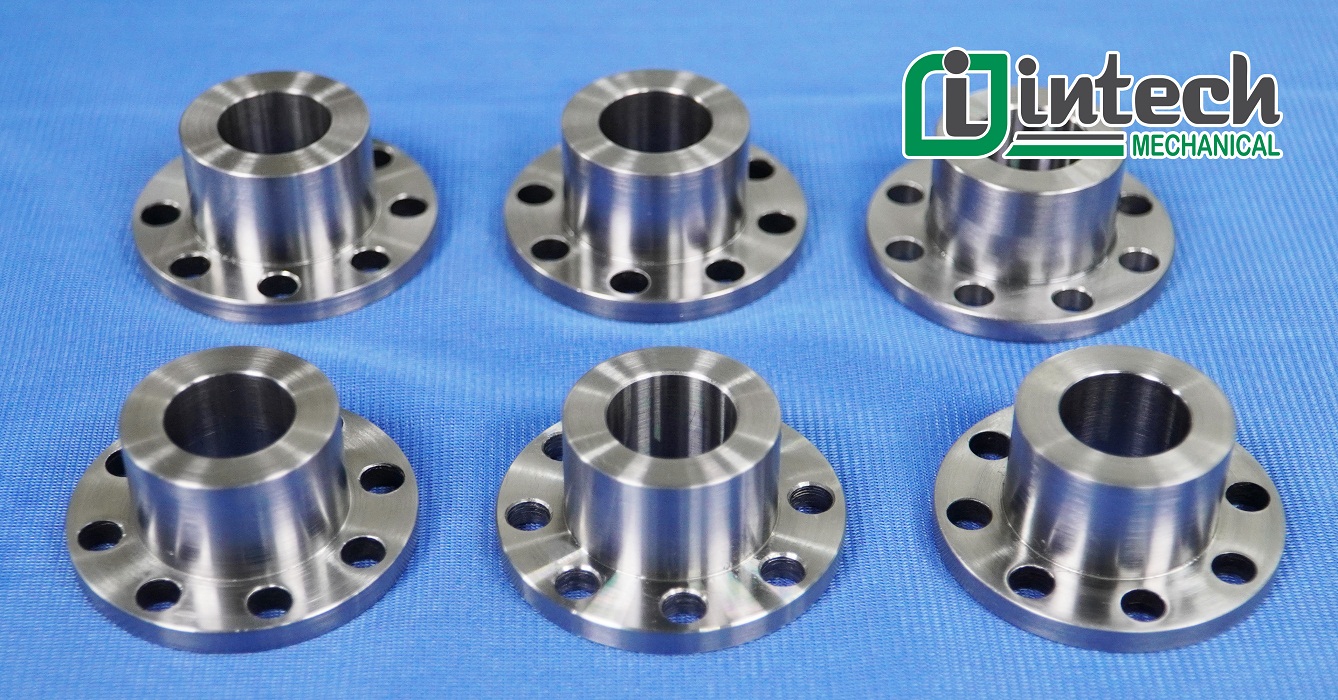
A standardized process at a reputable machining workshop ensures product precision and consistent quality:
Finished machined products must strictly adhere to the following technical specifications:
To produce high-quality machined flanges, the manufacturing workshop must strictly control six core factors:
Precision-turned flanges find widespread application across various sectors:
Intech Mechanical possesses extensive experience in precision machining, specializing in high-quality, custom turning services for both domestic and international enterprises.
- Custom flange machining based on drawings:
- Material consultation and optimal machining strategies:
Intech’s experienced engineering team is ready to analyze design structures, advise on material selection, and propose the most efficient combination of turning, drilling, and milling processes. Our goal is to ensure products meet technical performance standards while maximizing cost savings for the client.
- Strict quality control and delivery scheduling:
- Quotation request process at Intech Mechanical:
CONTACT FOR A QUOTE
If you require precision flange turning services tailored to your specifications, please contact Intech Mechanical immediately via Hotline or Zalo to receive free technical consultation and the most competitive quote today!
What is flange turning?
Flange turning is a machining process that removes excess metal from a rotating workpiece using a lathe tool to produce a flange with the shape, dimensions, and surface finish specified in the design drawings.
During the turning process, the flange workpiece rotates around the machine's axis, while the linear movement (longitudinal or transverse) of the cutting tool removes material to shape the characteristic rotational surfaces.
Key areas of the flange typically machined via turning include:
During the turning process, the flange workpiece rotates around the machine's axis, while the linear movement (longitudinal or transverse) of the cutting tool removes material to shape the characteristic rotational surfaces.
Key areas of the flange typically machined via turning include:
- Face (working face/sealing face): The surface that makes direct contact with the gasket or the mating flange.
- Outer Diameter (OD): Defines the overall diameter of the component.
- Center Bore (ID) and stepped bores: Used for inserting pipes, mounting shafts, or assembling auxiliary components.
- Gasket grooves and chamfers: Create space for gaskets (such as RTJ or RF grooves) and eliminate hazardous sharp edges.
- Distinguish between flange turning and general flange machining.
Many customers often confuse these two concepts. Reality:
- Flange turning: Only focuses on processing circular surfaces (face turning, outer diameter turning, hole turning, creating steps, cutting grooves).
- Overall flange processing: Is a series of manufacturing operations to complete a flange detail. In addition to turning, this process may require drilling of bolt holes (on a drill/milling machine), graduated tapping, milling of keyways, precision boring or heat treatment/surface plating.
The role of the turning operation in flange machining
Turning is the critical machining operation that establishes the structural framework and core geometric parameters of the flange:
- Ensuring concentricity: Aligning the inner diameter, outer diameter, and locating steps.
- Achieving face flatness: Preventing surface warping to ensure a perfect seal when bolts are tightened.
- Achieving surface smoothness (Ra roughness): Creating a sealing surface compatible with specific gasket types (rubber, metal, graphite, etc.).
- Ensuring assembly dimensions: Facilitating precise connection to piping systems or machinery without axial misalignment.
Flanges are typically machined by turning.
- Steel flanges:
- Characteristics: Carbon steel (e.g., C45, SS400, A105) offers good load-bearing and pressure-resistant capabilities at a reasonable cost.
- Machining: The material is relatively easy to turn, and chips evacuate well. Commonly used in industrial piping systems and structural connections for heavy-duty machinery.
- Stainless steel flanges:
- Common materials: Stainless steel 304 (SUS304), 316 (SUS316), and 201.
- Machining characteristics: Stainless steel is tough and ductile; it is prone to chip welding (adhesion to the tool), generates significant heat, and undergoes work hardening during cutting.
- Technical considerations: Select turning inserts specifically designed for stainless steel, maintain appropriate cutting speeds, and ensure continuous cooling with high-quality coolant.
- Aluminum flanges:
- Characteristics: Lightweight, good atmospheric corrosion resistance, and high aesthetic appeal.
- Machining: Aluminum is soft and easy to cut at high speeds but is susceptible to deformation from chuck clamping forces.
- Technical considerations: Use turning tools with large rake angles and polished insert surfaces to prevent chip adhesion, and carefully adjust clamping force to an optimal level.
- Cast iron and other materials:
- Cast iron flanges (gray iron, ductile iron): Chips are granular/crumbly; the material has self-lubricating properties due to graphite content but generates significant dust. Dust extraction systems and careful fixturing are required to prevent cracking or breakage.
- Special materials: Copper and engineering plastics (POM, Teflon) are used in high-grade chemical environments or applications requiring electrical insulation.
- Classification by structure and intended use:
- By shape/structure: Flat circular flanges, weld neck flanges, slip-on flanges, blind flanges, and flanged joints with locating grooves or steps.
- By purpose: Standard pipeline connection flanges, industrial machinery flanges, and transmission coupling flanges manufactured according to custom specifications.
Common flange facing methods
The entire flange facing process on a lathe comprises multiple minor operations:
- Facing the flange face
The objective is to create a flat surface perpendicular to the axis of rotation. This operation determines the overall thickness of the flange and the face runout. Precise facing minimizes the risk of fluid leakage when the bolts are tightened.
- Outer diameter turning
Feed the cutting tool axially to bring the workpiece's outer diameter to the design dimension. Simultaneously, this step forms the cylindrical outer wall and the transition sections (flange shoulders).
- Internal and stepped hole turning
A boring tool is used to enlarge the center hole of the flange workpiece to the desired internal diameter. If the flange features locating steps or requires a bearing mounting shoulder, the boring tool cuts these stepped profiles with precision. Should strict surface finish and tolerance requirements apply, the component may undergo a final reaming operation.
- Grooving, chamfering, and step turning
- Grooving: Cutting grooves for O-rings or RTJ sealing gaskets.
- Chamfering: Beveling the outer diameter and bore edges at 45° or 30° angles to remove burrs and facilitate safe pipe insertion or assembly.
- CNC turning of flanges
- Advantages: Exceptional precision, high machining speed, and high product-to-product repeatability.
- Applications: Suitable for mass production orders, components with complex profiles, and flanges requiring tight tolerances (±0.01 mm to ±0.02 mm).
- Flange turning on a universal lathe:
- Advantages: Rapid setup, low investment cost, and flexibility for direct adjustments.
Applications: Suitable for single-unit production, prototyping, refurbishing existing flanges, or machining extra-large diameter flanges that exceed the capacity of standard CNC machines.
Custom flange turning process
A standardized process at a reputable machining workshop ensures product precision and consistent quality:
- Step 1: Drawing review: Engineers analyze 2D/3D drawings, tolerances, surface roughness (Ra), materials, and quantities.
- Step 2: Material & blank selection: Prepare the blank (solid stock, forged, or cast) with an appropriate machining allowance to optimize costs and processing time.
- Step 3: Workholding & alignment: Use suitable chucks and dial indicators for precise alignment while avoiding workpiece deformation.
- Step 4: Rough & finish turning: Perform rough turning to rapidly remove excess material, followed by high-speed finish turning to achieve required precision and surface smoothness (CNC drilling/milling may be performed for bolt holes).
- Step 5: Quality Control (QC): Inspect technical specifications, flatness, runout, and contact surface roughness.
- Step 6: Finishing & handover: Deburr, apply anti-rust oil, or wrap in protective PE film before packaging and delivery.
Technical requirements for precision flange turning
Finished machined products must strictly adhere to the following technical specifications:
- Dimensional accuracy: Tolerances for diameter, thickness, and groove depth must comply with the engineering drawings and intended application.
- Flatness and face runout: The flange face must be flat and perpendicular to the axis to ensure uniform bolt-tightening force and prevent pressure leakage.
- Concentricity: The center bore and outer diameter must be perfectly concentric to prevent vibration and wear during assembly.
- Surface roughness (Ra): Must meet requirements based on the gasket type (e.g., Ra 0.8–1.6 for metal gaskets, Ra 3.2–6.3 for non-metallic gaskets).
- Burr and deformation control: Sharp edges must be chamfered, and clamping force must be controlled when handling thin flanges to prevent deformation.
Machinery and tools used in flange turning operations
| Tool / Equipment | Common type name | Role in the flange facing process |
| Lathe | Horizontal/vertical CNC lathe, universal lathe | Provides workpiece rotation and tool cutting motion. |
| Turning Tools | Carbide and CBN Inserts | Facing tools, external turning tools, boring tools, gasket grooving tools, chamfering tools. |
| Workholding | 3-jaw chuck, 4-jaw chuck, soft jaws, specialized fixtures | Securely position and clamp the workpiece; minimize runout and deformation. |
| Measuring instruments | Calipers, micrometers, dial indicators, roughness testers | Measuring dimensions, checking geometric tolerances and surface finish. |
Factors affecting the quality of flange turning
To produce high-quality machined flanges, the manufacturing workshop must strictly control six core factors:
- Quality of input blanks: Blanks must be free from porosity (for castings), warping, or internal cracks, and possess uniform hardness.
- System rigidity (Machine – Tool – Fixture): The lathe must be free of backlash, the chuck must clamp securely, and the tool holder should be short and rigid enough to minimize cutting vibrations.
- Optimal cutting parameters: Cutting speed (v), feed rate (f), depth of cut (ap), and proper coolant application help extend tool life and ensure a smooth, glossy surface finish.
- Process sequence: A logical division between rough turning (to relieve residual stress) and finish turning (to achieve precise dimensions).
- Technician expertise: Proficiency in reading technical drawings, CNC programming capabilities, and practical problem-solving skills at the machine.
- Quality control (QC) process: Periodic inspections at each machining stage rather than relying solely on a final inspection of the finished product.
Applications of post-machining flanges
Precision-turned flanges find widespread application across various sectors:
- Industrial piping systems: Conduits for oil and gas, chemicals, steam, wastewater, and high-pressure compressed air.
- Equipment assembly: Connecting pump housings, industrial valves, motors, gearboxes, and rotary drive assemblies.
- Automation lines: Robot mounting flanges, rotary table connection flanges, and production conveyor systems.
- Food & Pharmaceutical industries: Use of 304/316 stainless steel flanges with ultra-smooth turned surfaces to meet stringent hygienic standards.
- Energy & Shipbuilding sectors: Heat exchanger systems and marine piping subject to heavy loads and high impact forces.
Custom flange turning services at Intech Mechanical
Intech Mechanical possesses extensive experience in precision machining, specializing in high-quality, custom turning services for both domestic and international enterprises.
- Custom flange machining based on drawings:
- We handle the machining of all flange types, ranging from simple to complex designs, based on 2D/3D drawings or physical samples provided by the client.
- Flexible processing across a wide range of materials: Carbon steel, alloy steel, stainless steel (SUS304, SUS316), aluminum, copper, cast iron, etc.
- Material consultation and optimal machining strategies:
Intech’s experienced engineering team is ready to analyze design structures, advise on material selection, and propose the most efficient combination of turning, drilling, and milling processes. Our goal is to ensure products meet technical performance standards while maximizing cost savings for the client.
- Strict quality control and delivery scheduling:
- Rigorous quality management systems.
- 100% of flange products undergo meticulous inspection for tolerances, run-out, and surface roughness before leaving the workshop.
- Commitment to on-time delivery, complete with inspection documentation and packaging that meets shipping standards.
- Quotation request process at Intech Mechanical:
- Request submission: Clients send drawings, material specifications, and quantities via Intech’s email or Zalo.
- Technical assessment: The technical department analyzes the drawings, assesses feasibility, and plans the machining process.
- Detailed quotation: Intech provides a cost-optimized quote and a confirmed delivery schedule. Production & Delivery: Fabrication, quality control (QC) inspection, and on-site delivery.
CONTACT FOR A QUOTE
If you require precision flange turning services tailored to your specifications, please contact Intech Mechanical immediately via Hotline or Zalo to receive free technical consultation and the most competitive quote today!
- Hotline: 0966 966 205
- Email: cokhichinhxac@intech-group.vn
