


-

Machining of high-hardness machine components
Machining high hardness machine components is the process of shaping, cutting, and finishing to manufacture mechanical parts from materials with outstanding hardness (usually 45–65 HRC or higher) or steel billets that have gone through heat treatment (tempering, tempering, carburizing, induction hardening).
-

Turning of heat-treated steel
Hard turning is employed as an alternative to grinding for high-hardness, heat-treated steels. This process utilizes ultra-hard cutting tools made of CBN, PCBN, or PCD.
-

CNC turning of small parts
Machining small components requires a perfect combination of state-of-the-art equipment, advanced cutting tool technology, and the engineer’s practical expertise.
-

Mass production turning with hard chrome plating
Turning operations on hard chrome-plated materials ensure precision down to the finest detail without compromising any of the product’s critical dimensions.
-

Flange turning
Flange turning is a mechanical machining process that removes excess metal from a cylindrical workpiece using a turning tool to produce a flange with the shape, dimensions, and surface finish specified in the design drawings.
What is turning?
Turning is a mechanical machining process used to shape axisymmetric parts (such as shafts, threads, and tubes) by rotating the workpiece while a cutting tool moves linearly to remove excess material. This process ensures high precision and a smooth surface finish for the product.
- Operating principle:
The operating principle of a lathe is straightforward: the workpiece rotates continuously, while the cutting tool moves linearly (in a straight line) to cut into the workpiece—either longitudinally or transversely—to create the desired shape.
Characteristics and operating mechanism of traditional turning
1 - Main components
- Headstock: Houses the main spindle and the gearbox. The spindle holds the workpiece and transmits rotational motion to it; this provides the cutting motion (the rotation of the workpiece).
- Tailstock: Located opposite the headstock. It is used to support the other end of long workpieces (via a center) or to mount tools such as drill bits, reamers, or taps for machining holes in the workpiece.
- Carriage: The component that holds the turning tool. It allows the tool to move longitudinally along the workpiece (providing the feed rate - s) and transversely (determining the depth of cut - t). This provides the feed motion (the linear movement of the tool).
2 - Operation
Relies entirely on the skill of the lathe operator to adjust machining parameters.
- Cutting speed: The operator selects the spindle rotation speed (RPM).
- Feed rate: The operator adjusts the movement speed of the tool carriage.
- Depth of cut: The operator adjusts the depth to which the tool engages the workpiece.
- Lower initial investment cost compared to CNC lathes.
- Flexible for one-off production or workshop repair tasks.
- Easy to operate for simple parts without the need for programming.
- Lower accuracy and repeatability due to heavy reliance on the operator's manual handling.
- Lower productivity; the machining process is slow.
- Difficult to machine complex surfaces (such as contoured profiles) because the operator must control the process manually.
Commonly used turning methods today:
Turning encompasses a variety of methods utilizing different cutting tools to fully meet product manufacturing requirements. Below are five methods commonly used today:
- External cylindrical turning:
This is a method for machining the external surface of a product. A lathe and a cutting tool are used to machine the outer surface; operations can include long cylindrical turning, wide finishing cuts, and transverse (facing) turning.
- Rough turning: This process removes the outer layer of the workpiece—eliminating irregularities and surface imperfections—while simultaneously shaping the part and revealing any defects in the raw material. The depth of cut typically ranges from 4 to 6 mm. Rough turning can be performed in layers, in sections, or via a combination of both. It does not require high precision.
- Semi-finish turning: This is an intermediate step between rough turning and finish turning, designed to remove additional material from the workpiece and facilitate the finish turning process. The cutting depth typically ranges from 2 to 4 mm.
- Finish turning: This is the final stage for surface finishing, utilizing specialized turning tools to remove a relatively thin surface layer at high speeds 1,000 - 1,500 m/min for aluminum alloys and 200 - 250 m/min for other metals. This process demands high precision.
- Internal turning (Boring):
- Parting-off (Cut-off turning):
A method that shares the same fundamental principles as external cylindrical turning but involves stricter operational requirements.
- Thread turning:
This process can be performed using standard turning tools, making it widely used in many machining facilities. However, productivity is relatively low when cutting small-diameter threads, fine pitches, or when tool rigidity is insufficient.
- Facing:
Performed by moving the tool perpendicular to the workpiece's axis of rotation. It is used to flatten and prepare the end surface of the part, ensuring it is perpendicular to the central axis.
- Taper turning:
External and internal taper turning creates surfaces where the diameter gradually changes along the length of the part.
- Grooving:
Creates U-shaped, V-shaped, or square grooves on the external cylindrical surface.
- Form turning:
Uses a specially shaped tool (form tool) or a combination of movements to create surfaces with complex profiles, rather than simple cylindrical or conical shapes.
What is CNC turning?
 |
CNC turning is quite similar to CNC milling. However, unlike CNC milling—where the workpiece remains stationary while the cutting tool rotates against it—in CNC turning, the cutting tool remains stationary while the workpiece rotates against it.
CNC turning is a manufacturing process that creates parts by rotating the material against a stationary cutting tool to achieve the desired shape.
Why choose CNC turning?
CNC turning is ideal for creating cylindrical shapes or parts that are symmetrical around their axis, such as chess pieces, bolts, rivets, bearings, and washers. CNC turning also addresses certain manufacturing challenges associated with CNC milling. For instance, it allows for the easy creation of undercuts or grooves, whereas CNC milling would require specialized cutting tools to achieve the same result.
CNC lathes also support cutting operations along 3, 4, or 5 axes, enabling processes such as taper turning, knurling, threading, and parting-off. This subtractive manufacturing process is particularly well-suited for rapid prototyping and low-volume production.
Furthermore, CNC turning can be used in conjunction with CNC milling to produce high-quality, precise parts that meet tight tolerances.
Applications of CNC turning:
Turning is an indispensable machining process in any mechanical workshop. CNC turning offers significant advantages over traditional manual lathes:
- It enables the machining of complex profiles that are beyond the capabilities of conventional manual lathes.
- It delivers high economic efficiency and superior product quality.
Turning plays a vital role in metal cutting and material removal operations. These methods involve the movement of both the workpiece and the cutting tool. The primary operating principle relies on the effective rotation of the workpiece to generate the cutting action, combined with the tool's linear feed movements (longitudinal and transverse).
Standard CNC Turning Process
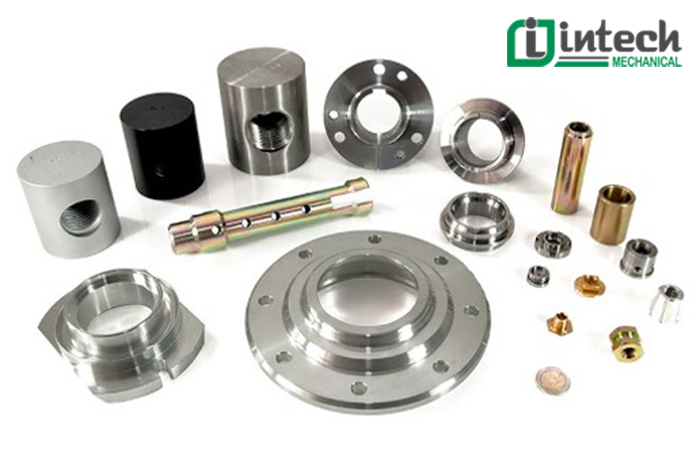
Producing a high-quality part via CNC turning involves numerous steps and stages. Intech Precision Engineering outlines the fundamental steps below as a reference for those new to the precision engineering industry:
 |
1. Workpiece and material inspection:
Measure the workpiece dimensions against the drawing specifications and verify the material.
2. Rough turning:
Determine the rough turning strategy based on the part's specified dimensions and the actual measured dimensions of the workpiece.
3. Design data review and CAD modeling:
Verify details on the drawing, including dimensions, geometry, surface roughness, and material specifications.
4. CAM programming (converting CAD files into machining code):
- CAM (Computer-Aided Manufacturing) evolved from CAE (Computer-Aided Engineering) and is typically used in conjunction with CAD (Computer-Aided Design).
- Verify the CAM program.
5. CNC lathe setup:
- Check the part's machining dimensions.
- Remove unnecessary programs from the machine. Since CNC programs vary by daily task, carefully clear out existing programs.
- Install the cutting tool.
- Set the X-axis so the chuck center aligns with the tool tip.
- Calibrate the tool length. Mount the cutting tool and the workpiece fixture on the chuck.
6. CNC lathe operation:
- Operate the machine to process the workpiece.
- Measure and inspect dimensions against the required technical drawings.
What are the advantages of CNC turning?
- Reduces reliance on the manual skills of the machinist.
- Operations are based on pre-programmed software, resulting in high efficiency and precision without requiring advanced technical expertise from the operator.
- Human involvement is limited to supervision and monitoring rather than directly performing the machining work.
- Reduces manpower requirements and production costs, thereby lowering the final product price.
- Ensures consistent precision across every machined product.
To leverage these strengths and mitigate weaknesses, Intech Precision Machining has equipped itself with a suite of high-quality CNC machines, including: Haas CNC milling machines, Focus CNC FBL-200L lathes, CNC wire-cut EDM machines, CNC grinders, CNC laser cutters, CNC press brakes, CNC punch presses, and more.
Intech Precision Machining selects the most suitable machine for each product to maximize strengths and ensure optimal quality, cost-efficiency, and production schedules.
Disadvantages and considerations regarding CNC turning:
- CNC turning capabilities depend on the part's geometry; highly complex products may require CNC milling instead.
- Productivity and precision are influenced by the cutting tools, the workpiece material, and the operator's skill level.
10 basic steps for operating a CNC lathe:
There are many different types of CNC lathes; here, Intech Precision Machining outlines the general operating steps for the Focus CNC FBL-200L lathe for reference.
- Step 1: Power on: Turn on the machine's power switch.
- Step 2: Return to reference point: Ensure the machine table and tool axis move to the machine's reference position.
- Step 3: Select tool: Choose the appropriate tool based on the specific machining requirements for the part.
- Step 4: Mount workpiece: Set up the workpiece, determine the mounting method, and establish the coordinate origin for the part.
- Step 5: Close machine door: After mounting the part, selecting the tool, and setting the coordinate origin, close the machine door (by pressing the close button).
- Step 6: Adjust parameters.
- Step 7: Safety tool compensation: Select tool length and tool diameter compensation modes.
- Step 8: Load program: Select the pre-programmed machining program.
- Step 9: Apply tool compensation for machining.
- Step 10: Machining: The machine processes the part according to the programmed instructions.
Product requirements for CNC turning
There are various methods available for the turning process, resulting in differing levels of product precision. However, to produce high-quality parts, turning methods must meet specific requirements:
- Lathe precision: This depends on factors such as spindle runout, as well as the parallelism between the guideways and the spindle axis.
- High-precision turning requirements:
- Positional accuracy
- Concentricity between the external and internal surfaces of the machined part
Common materials for CNC turning:
* Metals:
- Aluminum: 2021, 5052, 6061, 6063, 7075, etc.
- Steel: 303, 304, 316, stainless steel, tool steel, carbon steel, etc.
- Brass
- Copper
- Special alloys: Kovar, Invar, Inconel, Titanium, MoCu, etc.
* Plastics:
- POM, PTFE, PEI, PA6
Intech Mechanical offers rapid and precise custom CNC turning services
Turning is a highly effective metal-cutting method widely used in mechanical machining. Products created via this method are primarily rotational in shape—such as smooth shafts, threaded parts, bores, and stepped shafts. The availability of various lathe sizes allows for a wide diversity of products.
At Intech Mechanical, we offer various turning methods to fully meet our customers' needs. Thanks to modern machinery and software systems, our precision mechanical products consistently ensure high quality and rapid turnaround times at the best prices.
Why choose Intech Mechanical's CNC turning services?
- Intech Precision Mechanical boasts years of experience in design and CNC turning in Vietnam. We partner with numerous domestic enterprises and FDI companies in Vietnam, while also exporting to international clients in markets such as South Korea and Japan.
- Our products are manufactured using standardized processes designed to simplify designs and facilitate ease of operation, all while ensuring high precision throughout the production cycle.
- High-precision manufacturing ensures product uniformity and reliable quality.
- Professional service and competitive pricing.
- Reliable delivery schedules.
Request a quote for CNC turned parts from Intech Mechanical:
- Address: Lot 6, Lai Xa Industrial Cluster, Tay Tuu Ward, Hanoi City
- Hotline/Zalo: 0966 966 484 – 0966.966.205
