


Mục lục
Mechanical shafts are core components in industrial machinery, responsible for transmitting torque and positioning rotating parts. Given that they operate under high loads and significant friction, CNC turning—based on precise technical drawings—serves as the optimal manufacturing solution, offering high accuracy, consistency, and rigorous quality control.
CNC (Computer Numerical Control) turning is an automated metal-cutting machining technology in which a metal workpiece rotates about an axis while a cutting tool moves along pre-programmed paths to create surfaces of revolution (such as cylinders, cones, end faces, grooves, and threads).
When performing CNC turning based on a technical drawing, a programmer digitizes the specifications—including dimensions, tolerances, surface roughness, and fillet radii—into machine code (G-code/M-code) to control the lathe. This process ensures precise control over key technical parameters:
Unlike mass-produced, off-the-shelf commercial products, custom-machined shafts offer several distinct advantages:
Depending on their functional role within a mechanism, CNC-machined shafts are categorized into various types:
1. Plain shafts and stepped shafts
2. Threaded shafts and splined shafts
3. Shaft for mounting ball bearings and bushings
4. Small shafts and shafts with complex profiles
5. Other specific types of shafts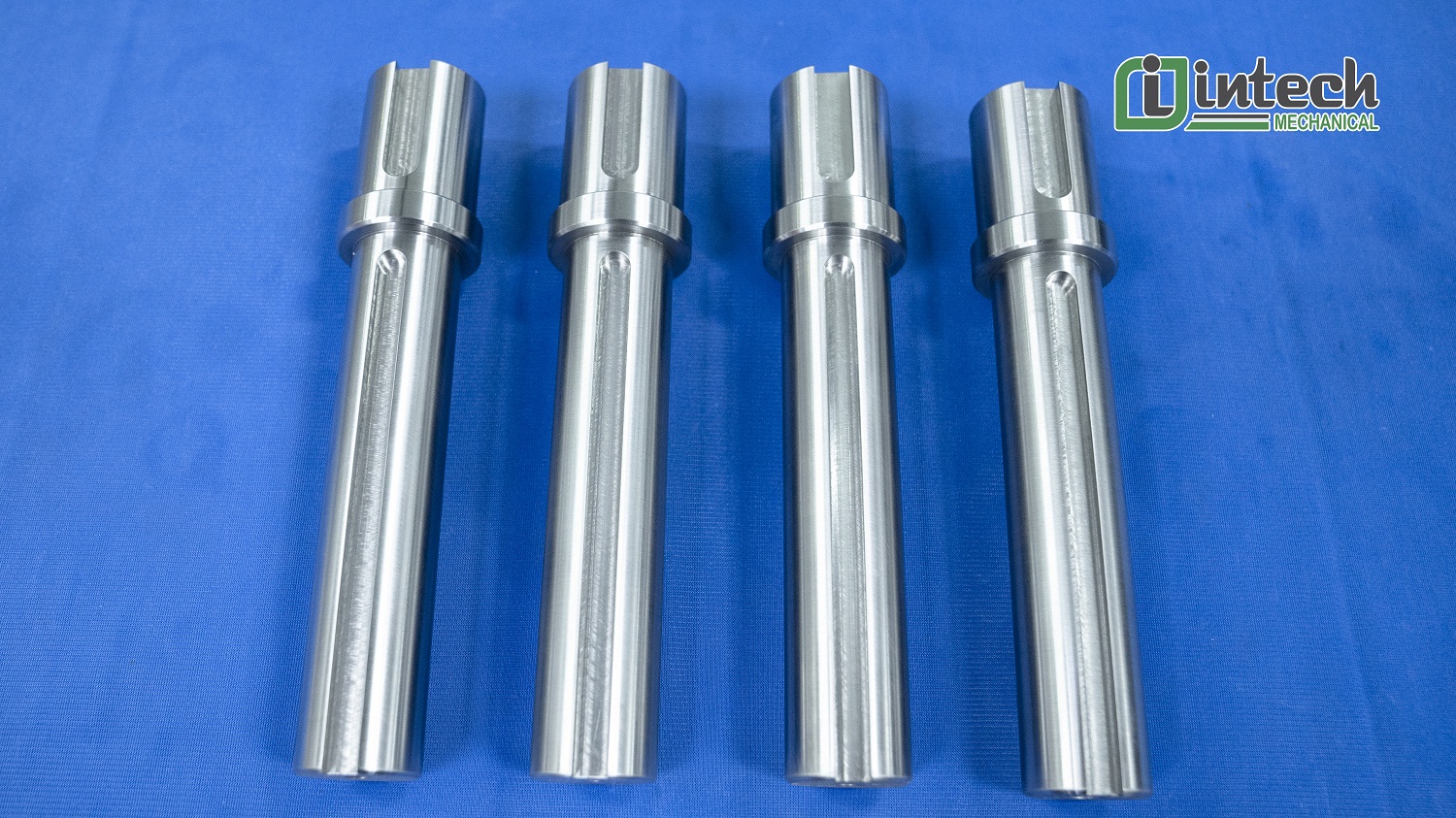
The choice of the right material determines 80% of the durability, lifespan, and production cost of a shaft component.
1. Carbon steel and alloy steel
2. Stainless steel
3. Aluminum and aluminum alloys
4. Copper and brass
Utilizing professional CNC turning services based on technical drawings offers several significant advantages:
CNC-machined shafts are utilized across nearly all industrial manufacturing sectors:
CNC shaft turning services based on technical drawings are essential for manufacturing high-quality mechanical components that offer both durability and precision. To achieve optimal part quality at the most cost-effective price, partner with Intech Mechanical—a company with extensive experience in precision mechanical machining.
Simply submit your technical drawings, along with the required quantities and material specifications. Our team of engineers will analyze the best machining approach and provide a detailed quote within 24 hours!
Free consultation on machining strategies
What is CNC turning?
CNC (Computer Numerical Control) turning is an automated metal-cutting machining technology in which a metal workpiece rotates about an axis while a cutting tool moves along pre-programmed paths to create surfaces of revolution (such as cylinders, cones, end faces, grooves, and threads).
When performing CNC turning based on a technical drawing, a programmer digitizes the specifications—including dimensions, tolerances, surface roughness, and fillet radii—into machine code (G-code/M-code) to control the lathe. This process ensures precise control over key technical parameters:
- Dimensions & Tolerances: The allowable limits of deviation for diameters and lengths.
- Surface Roughness (Ra, Rz): The degree of smoothness of the part's surface after machining.
- Material & Technical Processing: The selection of the appropriate metal type and heat treatment processes as required by the design.
Characteristics of shaft turning services based on technical drawings
Unlike mass-produced, off-the-shelf commercial products, custom-machined shafts offer several distinct advantages:
- Flexible input options: Production can be based on 2D technical drawings (DWG, PDF), 3D models (STEP, IGES), or by replicating an existing physical sample.
- Material versatility: Customers can specify the exact grade of steel, stainless steel, aluminum, or copper to suit specific operational requirements.
- Wide range of specifications: Capable of producing everything from small-diameter shafts (a few millimeters) to extra-long or large-scale shafts, depending on the equipment’s bed length and chuck capacity.
- Diverse production capabilities: Well-suited for a variety of needs, ranging from single-unit custom machining and prototyping to large-scale mass production.
Common types of CNC-machined shafts produced according to technical drawings
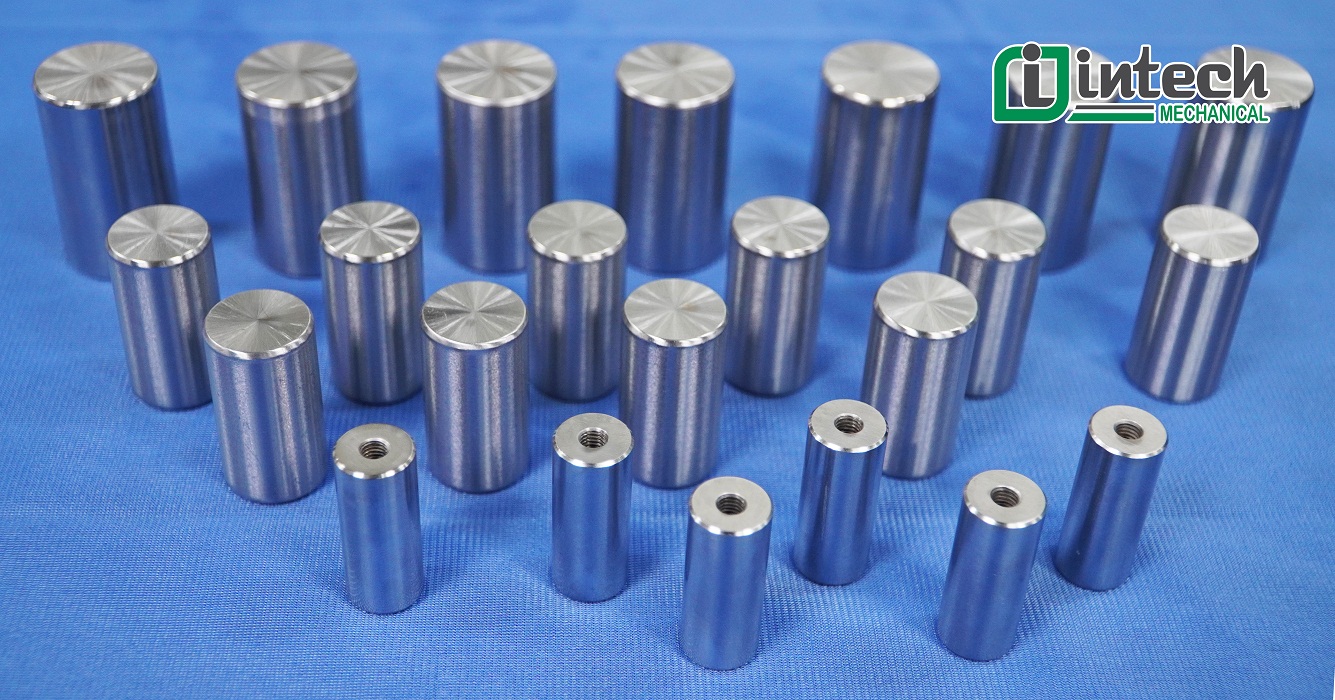
Depending on their functional role within a mechanism, CNC-machined shafts are categorized into various types:
1. Plain shafts and stepped shafts
- Characteristics: A plain shaft has a constant diameter along its entire length, whereas a stepped shaft consists of multiple sections with varying diameters that either decrease or increase.
- Technical requirements: Strict control is required for straightness, the diameter and length of each section, surface roughness, and—most importantly—the concentricity between the various sections of the shaft.
- Applications: Used as drive shafts or transmission shafts in gearboxes, conveyor systems, and industrial machinery.
2. Threaded shafts and splined shafts
- Features: The shaft surface incorporates various types of threads (metric, imperial, square, trapezoidal, etc.), tool relief grooves, retaining ring grooves, and keyways.
- Technical Requirements: Emphasis is placed on the precision of thread pitch, thread angle, and the effective (pitch) diameter of the threads, as well as the accurate positioning of grooves in accordance with the technical drawings.
- Applications: Lead screws for power transmission, mandrels, and positioning/connecting components within mechanical assemblies.
3. Shaft for mounting ball bearings and bushings
- Characteristics: These are the shaft seats (bearing seats) that come into direct contact with—and are assembled against—the inner ring of a rolling-element bearing or a bushing.
- Technical Requirements: Extremely strict assembly tolerances are required (typically following standards such as h6, js6, k6, etc.), along with a high surface finish (Ra ≤ 0.8μm) and perfect coaxiality.
- Note: For shaft seats requiring high hardness and precision, the component must typically undergo heat treatment and external cylindrical grinding (precision grinding) following the finish-turning stage.
4. Small shafts and shafts with complex profiles
- Characteristics: Shafts with a small diameter and significant length (prone to deflection during machining), or those featuring complex contours, conical surfaces, or chamfers.
- Technical requirements: The use of a steady rest or a follow rest is necessary to prevent vibration and runout, ensuring stability during setup.
5. Other specific types of shafts
- Shafts requiring combined milling, drilling, and tapping: These shafts involve operations such as milling keyways, drilling radial holes, and tapping the end faces. Such components are typically machined on CNC lathes equipped with a C-axis and live tooling.
- Custom-manufactured shafts (reverse-engineered): Customers provide a damaged part, which is then measured to create a 3D model, followed by the machining of a new replacement part.
- Shafts requiring surface treatment: After the turning process, these shafts undergo treatments such as electroplating (hard chrome plating, anodizing), thermal spraying, or heat treatment (induction hardening, carburizing).
Commonly used materials for CNC shaft turning
The choice of the right material determines 80% of the durability, lifespan, and production cost of a shaft component.
1. Carbon steel and alloy steel
- Common steel grades: S45C, C45, SCM440 (42CrMo4), SKD11, SKD61, 40Cr.
- Characteristics: High tensile strength, excellent load-bearing capacity, good machinability, and a reasonable price point.
- Applications: These are the most popular choices for manufacturing load-bearing steel shafts and gear shafts. Following rough or finish turning, the shafts can undergo induction hardening or carburizing to achieve a surface hardness of 50–60 HRC for wear resistance, while the core remains tough and ductile.
2. Stainless steel
- Common steel grades: SUS304, SUS316, SUS420, SUS430.
- Characteristics: Excellent resistance to oxidation and chemical corrosion. However, stainless steel is ductile, prone to sticking to cutting tools, and has poor heat dissipation during machining.
- Applications: Used in food processing machinery, medical equipment, chemical environments, and marine equipment. When machining stainless steel, engineers must select appropriate cutting parameters and use specialized cutting inserts.
3. Aluminum and aluminum alloys
- Common aluminum grades: A6061, A7075, A5052.
- Characteristics: Lightweight (one-third the weight of steel), easy to machine, good heat dissipation, and suitable for surface anodizing to enhance hardness and aesthetic appeal.
- Applications: Shafts in automation equipment, the aerospace industry, robotics, and components where reducing moving mass is required.
4. Copper and brass
- Material grade: Brass (C3604), tin bronze, or plated copper/brass.
- Characteristics: Good electrical and thermal conductivity; low coefficient of friction.
- Applications: Bushings, electrical contact components, decorative parts, or sliding mechanisms.
Advantages of CNC turning services based on technical drawings
Utilizing professional CNC turning services based on technical drawings offers several significant advantages:
- High precision and reliability: Capable of meeting the most stringent technical requirements specified in design documents.
- Absolute consistency: Ensures seamless mass assembly with an exceptionally low scrap rate.
- Manufacturing flexibility: CNC programs can be easily adjusted to accommodate design changes requested by the client.
- Optimized production costs: High processing speeds and a high degree of automation significantly reduce the cost per unit for medium- to large-scale production runs.
- Comprehensive quality documentation: Clients receive transparent dimensional inspection reports, facilitating effective quality control of incoming components.
Practical applications of CNC axes in industry
CNC-machined shafts are utilized across nearly all industrial manufacturing sectors:
- Machinery & Power Transmission: Gearbox shafts, crankshafts, gear shafts, and drive shafts for forklifts, automobiles, and agricultural machinery.
- Automation Lines: Conveyor roller shafts, linear guide shafts, and shafts for robotic pick-and-place systems.
- Pumps & Electric Motors: Motor rotor shafts, chemical pump shafts, and centrifugal turbine shafts—all requiring high coaxiality and dynamic balancing.
- Specialized Industrial Equipment: Rolling mill shafts for the paper and packaging industries, hydraulic cylinder shafts, and high-pressure nozzles.
Quotation for CNC shaft turning based on technical drawings
CNC shaft turning services based on technical drawings are essential for manufacturing high-quality mechanical components that offer both durability and precision. To achieve optimal part quality at the most cost-effective price, partner with Intech Mechanical—a company with extensive experience in precision mechanical machining.
Simply submit your technical drawings, along with the required quantities and material specifications. Our team of engineers will analyze the best machining approach and provide a detailed quote within 24 hours!
Free consultation on machining strategies
- Guaranteed 100% adherence to specified tolerances
- Support for both prototype development and mass production at competitive rates
Contact us for consultations and factory price quotes ›
