


-

Sheet metal bending
Intech Mechanical specializes in high-precision bending and folding services for steel, stainless steel, and various other materials, offering fast turnaround times.
-

Steel bending and folding
Steel bending is an advanced mechanical processing solution that transforms flat steel sheets into sharply defined shapes, precisely formed according to any technical drawing.
-

Bending of machine parts
Sheet metal bending is a forming process in which a flat metal workpiece is subjected to bending force from a press brake to shape it according to pre-designed angles and profiles.
-

Stainless steel bending and folding
Intech Mechanical offers custom CNC stainless steel bending services, adhering strictly to CAD/CAM drawings with ultra-tight tolerances. Competitive factory-direct pricing for 2026. Hotline/Zalo: 0966.966.205.
What is press brake bending?
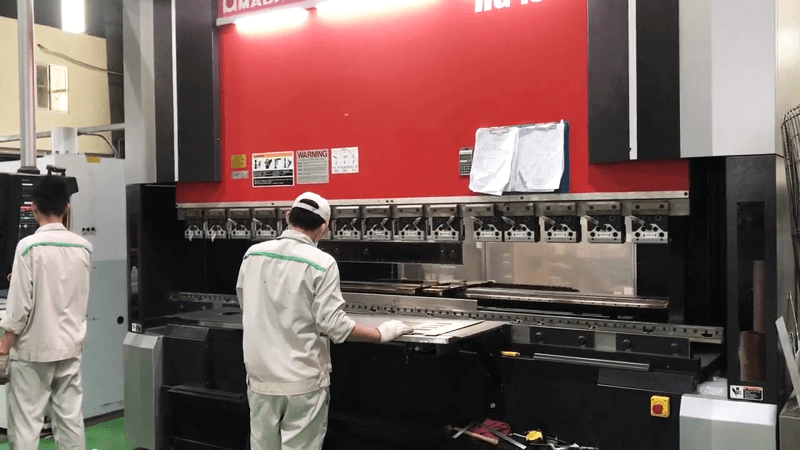 |
Press brake bending is a sheet metal forming process that involves bending or folding the material to achieve the angles and shapes specified in the design.
The process utilizes significant force, typically generated by a CNC press brake, applied to the sheet metal via a punch and die set to permanently deform the material, thereby creating the required angles and bends.
CNC press brake bending ensures uniformity, high speed, and superior precision through automated programming and control. It is one of the most fundamental and critical operations in sheet metal fabrication, determining the product's final 3D shape.
- The primary purpose of CNC bending:
- Detailed forming: Fabricating components with angles, edges, box-like shapes, or frames from flat sheet metal.
- High precision: Ensuring products meet exact technical specifications regarding angles and dimensions as per design drawings, facilitating subsequent assembly (e.g., electrical enclosures, machine frames, gutters).
3 Main CNC Bending Methods
Modern CNC machines enable the use of various bending methods to meet complex part requirements. The three main methods include:
1. Air Bending
- Principle: The punch presses the sheet metal down, but the material does not fully bottom out in the V-die; it only contacts the die shoulders.
- Angle control: The bending angle is controlled by the depth to which the punch enters the die (the extent to which the material is pressed down).
- Advantages: Various angles can be produced using a single set of tooling.
2. Molding trauma
This method is typically used when high angular precision is required.
- Principle: The punch forces the material into full contact with the angular surface of the die.
- Angle control: The bend angle is determined directly by the die angle (the die must have an angle matching that of the finished part).
- Advantages: High angular precision and minimized springback.
3. Hemming/Edge folding
This is the process for creating a safe and durable edge.
- Principle: It involves two steps:
+ Using a flat punch to flatten that acute angle into a tightly folded edge (180°).
- Purpose: To increase edge rigidity and durability, while also enhancing aesthetics and eliminating sharp edges.
Outstanding advantages of CNC bending technology
CNC bending technology has almost entirely replaced manual methods, offering the following key benefits:
- Absolute precision: Minimal margin of error (typically just ±0.1mm to ±0.2mm) thanks to automated programming and control. This ensures components strictly adhere to design specifications—a critical factor for parts requiring assembly.
- High productivity and speed: Ideal for mass production, offering significant time savings compared to manual methods. Capable of continuous, stable operation.
- Versatile shaping: Capable of producing complex profiles, including V-bends, U-bends, box shapes, curved bends, and multi-angle bends.
- Cost optimization: Minimizes material waste while reducing labor costs and processing time.
Materials commonly used in CNC bending
Press braking and bending processes can be applied to a wide range of materials, including:
- Stainless steel: Includes common grades such as 304, 201, and 316. Stainless steel is favored for its corrosion resistance, durability, and aesthetic appeal.
- Steel: Available in various types, ranging from hot-rolled and cold-rolled steel to steel plate, galvanized steel, and alloy steel. It is commonly used for structural components or applications requiring high mechanical strength.
- Aluminum (Aluminum alloy sheet): Lightweight, corrosion-resistant, and easy to process; frequently used in the aerospace, automotive, and architectural industries.
- Copper and Brass: Used for electrically conductive components or applications requiring high decorative and aesthetic value.
Thickness and dimensions to consider in bending operations
The thickness and length must be compatible with the machine's capabilities, while all dimensions and angles must be calculated with compensation to achieve maximum precision after bending.
1. Sheet metal thickness
- Common thickness range: CNC press brakes typically handle sheet metal ranging from very thin (approx. 0.3 mm) to quite thick (approx. 10 mm). However, some high-capacity machines can process sheets up to 20 mm thick or more.
- Impact on bending force:
+ Thinner metal: Requires lower bending force but demands greater precision in tool alignment to avoid deforming or tearing the material.
- Impact on bend radius: Thickness determines the bend radius (the curvature of the corner). Generally, a safe bend radius must be equal to or greater than the sheet thickness.
2. Dimensions (Length and width)
- Maximum length: Must be less than the working length of the bending machine (typically 1 to 4 meters).
- Workpiece dimensions: The dimensions of the initial cut metal sheet must be precisely calculated to ensure the finished part meets the required final specifications after bending.
- Bending angle: High precision is usually required (e.g., 90°, 135°, 45°, etc.). CNC machines can achieve angular precision with a tolerance of only ±0.1° to ±0.5°.
Products and practical applications of press brake bending
Components produced via bending and folding processes are found across a wide range of industries:
- Electrical/Automation: Electrical enclosures, equipment mounting frames, control boxes, and cable trays.
- Construction/Architecture: Gutters, wall cladding, flashing, window frames, and metal facades.
- Mechanical Engineering: Machine components, machinery frames, and protective housings.
- Furniture/Appliances: Metal furniture frames, shelving, TV stands, and air conditioner casings.
- Transportation: Structural parts and vehicle bodywork for the automotive and railway sectors.
High-precision sheet metal CNC bending and folding service in Hanoi
Intech Mechanical focuses on providing comprehensive sheet metal processing solutions, with bending serving as a key stage. We utilize modern CNC bending systems to shape sheet metal into components featuring precise angles, edges, and box-like structures, ensuring high accuracy and productivity.
- Reasons for choosing sheet metal bending services at Intech Mechanical
- ISO Quality: Implementation of the ISO 9001:2015 quality management system ensures rigorous process control from raw materials to the final product.
- Modern Machinery: Investment in advanced CNC equipment delivers superior precision and efficiency across all bending projects.
- Scale: A facility spanning over 4,000 m² and a team of more than 110 skilled professionals enable the handling of large volumes and complex requirements.
- CNC press brake system capabilities
A system of five press brakes with varying force capacities and sizes helps optimize production:
| STT | Shock Force | Maximum Shock Length | Suitable Applications |
| 1 | 220 Ton | 4.000 mm | Long components and thick plates (electrical cabinet enclosures, cable trays, long profiles) |
| 2 | 110 Ton | 3.100 mm | Medium-length components (cabinet doors, panels, structural frames) |
| 3 | 90 Ton | 2.000 mm | Medium-sized components (housings, brackets, mounting plates) |
| 4 | 60 Ton | 1.500 mm | Small components, mass production |
| 5 | 50 Ton | 1.200 mm | Small details, rapid prototyping, mass production |
- Accuracy control process
- Proprietary blank development: Flat blank dimensions are calculated based on specific tooling and actual material properties at the workshop—avoiding generic coefficients—to ensure the bent part meets precise dimensional standards without requiring rework.
- Bending sequence simulation: Processing sequences are determined in advance to eliminate tool collisions and minimize cumulative errors in multi-bend parts.
- Test bending and verification: For large orders, the first part undergoes rigorous angle and dimensional inspection before the full batch is processed.
- 100% specialized inspection: Measurements are taken using electronic angle gauges, calipers, and custom jigs; visual inspection alone is strictly prohibited.
- Aesthetic surface protection: Original protective films, anti-marring pads, and specialized die systems designed specifically for stainless steel and brushed aluminum are utilized.
Standard tolerance commitment:
- Chamfer angle: ±0.5°
- Dimensions: ±0.2mm (Applies to all materials).
* Note: Tolerances may vary based on product length (short products achieve near-absolute precision, while ultra-long products comply with specialized technical standards).
Technical design consultancy helps optimize costs and quality.
- Insufficient bend flange length: The flange must be long enough to rest securely on the die shoulders; otherwise, the edge may slip, resulting in an incorrect bend angle.
- Holes or slots too close to the bend line: High bending forces can stretch and distort holes. Solutions include relocating the hole, adding a relief cut, or cutting the hole after bending.
- Missing corner relief: Corners where two bends meet require relief cuts to prevent the material from tearing.
- Inner bend radius: Selecting a radius that matches available tooling saves on costs. Conversely, using a radius that is too tight for hard or thick materials can lead to cracking.
- Material grain direction: With hard aluminum and high-strength steel, bending parallel to the grain increases the risk of cracking. We orient the blank so that the bend line runs across the grain.
- Functional dimensioning standards: Clearly specifying internal/external dimensions and mating reference surfaces on the drawing prevents misinterpretation of the design intent.
- Quotation for CNC sheet metal bending services
The cost of bending services depends on various factors, such as dimensions, thickness, shape, material, and production volume; therefore, there is no standard fixed price.
Every finished part in a batch, from the first to the last, maintains precise angles and dimensions, verified using professional technical instruments. If you require custom mechanical processing or CNC bending services, please send us your drawings to receive a prompt and accurate quote.
- Hotline/Zalo: 0966.966.205
- Address: Lot 6, Lai Xa Industrial Cluster, Tay Tuu Ward, Hanoi City
